Tracking the Snowshoe Hare
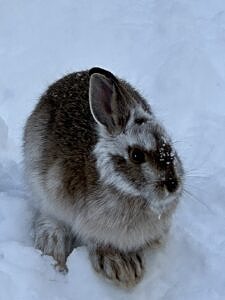
A snowshoe hare on Mount Moosilauke, partway through molt, with patches of summer brown and winter white. (photo © Emma Kluge)
In the darkness of a long winter night, the stars glitter like tremendous, bright snowflakes. Curtains of aurora borealis might illuminate the white landscape in unbelievable shades of magenta and chartreuse. High on the mountain slopes of New England, the wind is relentless and dangerously cold; it piles deep drifts of snow among the frozen trees. The temperature drops well below freezing for weeks at a time. How could anything be alive up here? Apart from the wind shuddering through the ice-encapsulated firs, you hear — almost — nothing. Almost silence.
But there — a tiny, nearly inaudible sound. A gentle nibbling, a rustle of low branches. By the faint light of the crescent moon and the countless stars, you can barely make out a small shape hunched in the underbrush. What animal in its right mind wouldn’t be hibernating in such a harsh, hibernal landscape?
The hardy beast in question is the snowshoe hare (Lepus americanus), a shy creature who remains active all winter. While more common in the boreal forests of northern and high-elevation areas of the state, snowshoe hares can be found throughout New Hampshire, including conifer stands and mountain slopes in the Monadnock Region.
Built for Northern Winters
These lagomorphs have several remarkable adaptations that help them survive northern winters. Their namesake feet are gigantic with toes that splay widely, acting like snowshoes to keep them afloat in deep snow. Plenty of foot fur — far beyond hobbit levels — provides insulation and traction. Their strong, powerful hind legs can propel them up to twelve feet in a single bound, and hares can run 30 miles per hour.
Also called the “varying hare,” they present with two coat phenotypes, or colors: brown in the summer, to camouflage with brush and dirt, and white in the winter, to camouflage with snow. Their winter coats are thicker, but also warmer due to hollow hairs that help trap body heat. In New England hares, the transition takes about ten weeks, beginning in mid-October and again in late March. Hares top the menu for bobcats, foxes, owls, hawks, and fishers, among other predators; their variable camouflage helps them avoid being eaten while they rest and forage.
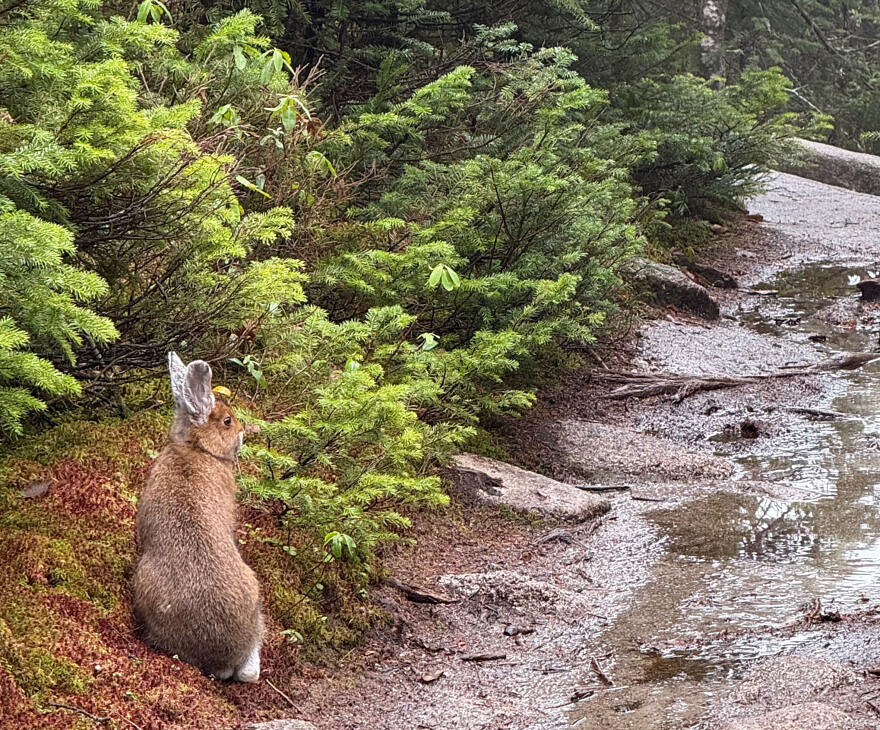
Seen on Cannon Mountain in October 2025, this hare’s ears and back feet have just begun to change to its winter white coat. (photo © Selah Ray Wittig)
Adapting to a Changing Climate
As our climate changes, first snows have come later and melt-off has begun earlier. On average, the snowpack lasts for fewer days. Snowshoe hares’ coat change is triggered by length of daylight, not temperature or precipitation, leading to a camouflage mismatch – hares are white before and after the shortened snow season, and are thus more likely to be spotted by predators.
Significant increase in predation creates strong evolutionary pressure, and change can be surprisingly fast in species with short, large generations. (Like most lagomorphs — the animal order that includes rabbits, hares, and pikas — snowshoe hares are prolific, often having several litters of babies, called leverets, each year.) There is evidence that some northwestern populations are already adjusting to decreased snow: in these areas, some individual hares are only partially white or even entirely brown throughout the winter.
While they prefer a lush salad of fresh greens, berries, and grasses, winter doesn’t offer a buffet of leafy vegetation. This time of year, snowshoe hares will ingest less nutritious parts of plants, including twigs, bark, and buds. As they lack the complex and bulky digestive systems that would allow them to fully process their woody meal on the first pass, they often reingest their own droppings in order to extract further nutrients. (In case you’re looking for a new word to impress your friends, this is called coprophagy.)
Winter adaptations are a great example of convergent evolution, in which unrelated species separately evolve similar traits and behaviors. There are about twenty species worldwide which turn white in winter, including Arctic foxes, ptarmigans, and a few weasel species, including our local ermine. Canada lynx and snow leopards exhibit large “snowshoe” paws, similar in morphology to those of the snowshoe hare. Deer and squirrels can digest woody plant growth in the winter if their preferred diet is unavailable.
Signs in the Snow
Primarily crepuscular and nocturnal, hares rest during the daytime in shallow depressions in the snow or brush (called forms). You’re somewhat unlikely to run into one on an afternoon hike, but winter offers plenty of evidence that they’re near. Look for signs in their preferred softwood forests with dense underbrush, which provides cover from their numerous predators.
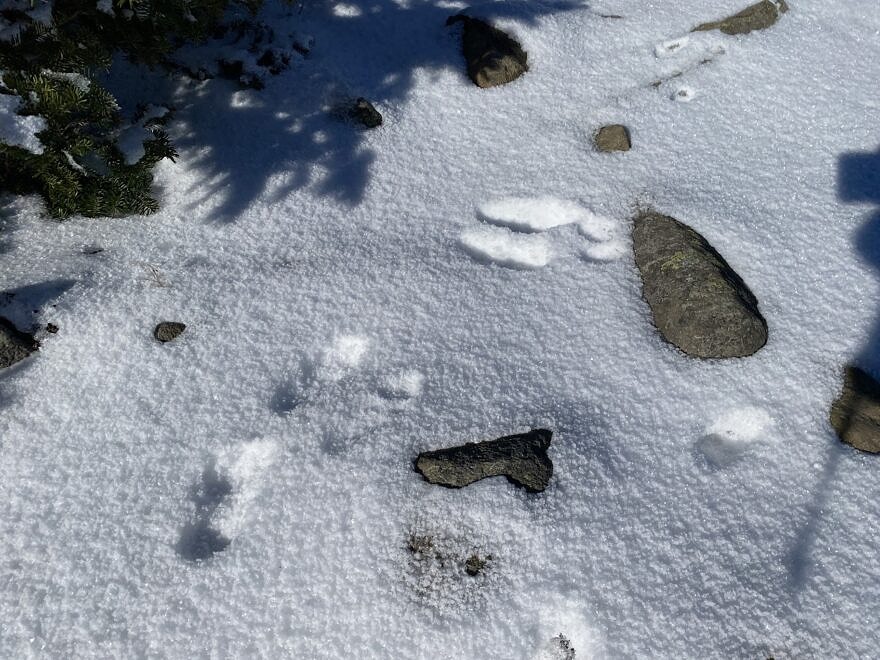
Multiple snowshoe hare tracks in snow at about 4500’ on Mount Moosilauke. The larger impressions are the hind feet, which land in front of the front feet, indicating direction of travel. The tracks on the bottom left were made by an animal traveling toward the top right of the photograph. The tracks on the top were made by an animal — most likely the same hare — traveling toward the lefthand side of the photograph. (photo © Emma Kluge)
Their signature tracks – two small circles and two larger ovals — can frequently be found in the snow. The larger ovals are made by their gigantic hind feet landing in front of their smaller front paws. The direction of travel can generally be inferred by imagining an arrow from the smaller prints toward the larger prints. And of course, there’s always scat to indicate a hare is hiding nearby — look for piles of cocoa puffs in the snow. (That is, of course, assuming there hasn’t been any of that coprophagy going on.)
Look, also, for the “hare line” — snowshoe hares can eat only what they can reach, in some cases leaving visible browse lines in vegetation, beginning about two feet off the ground. In places with heavy snowpack, the snow acts as a platform for hares, so the forage line can be considerably higher — nature’s receding hare line, perhaps? In fact, newer growth, found on upper branches, is typically higher value and more digestible, so deeper snowpack can be counterintuitively advantageous for hares, allowing them access to better sources of winter nutrition.
If you’re lucky enough to come across a snowshoe hare on your next adventure, take a moment to admire its impressive ability to survive our harsh — but beautiful — New England winters.
This story was originally published in the Monadnock Ledger-Transcript on January 28, 2026.
Emma Kluge

Emma Kluge (she/her) spent ten years as an elementary school teacher, with a focus on developing science- and nature-based curricula. She holds a BA in Environmental Science from Ithaca College and a Master of Science in Teaching from SUNY Cortland.
Originally from New York State, Emma has lived in diverse landscapes across the country, from the mountains of New Mexico to the Great Lakes of Michigan and, of course, beautiful New England. Her experiences in these varied ecosystems have shaped her perspective and deepened her appreciation for the natural world. She is thrilled to return to New Hampshire, where she can immerse herself in the region’s rich ecological heritage.
Outside of work, Emma is a road trip fanatic and (sometimes over-eager) hiker. Her husband and excellent, ancient dog often accompany her on adventures. As a lifelong naturalist and outdoor enthusiast, she is dedicated to fostering connections between people and the natural world.


