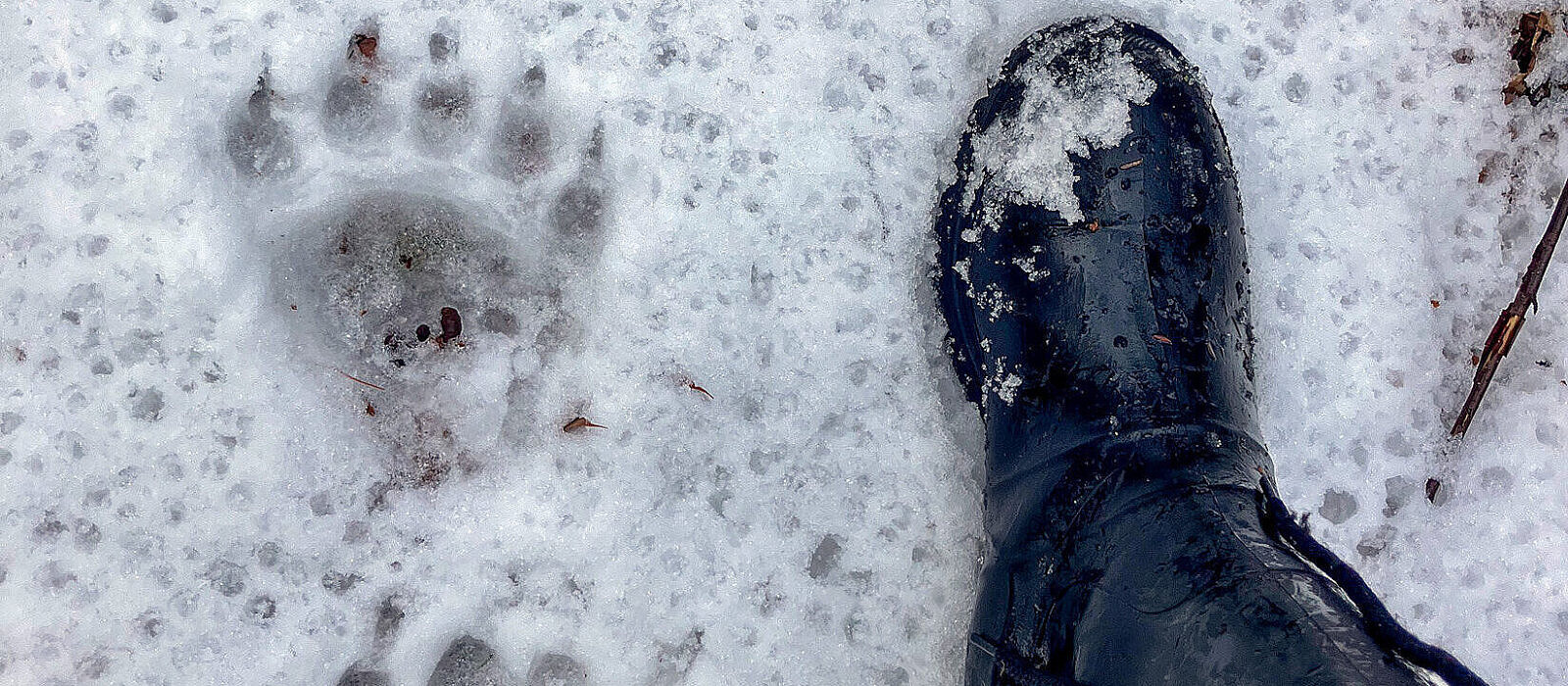
We are kneeling in the snow on a cold winter’s day. Our mittens are off and my fourth grade students are running their fingers along the rippled paw prints of the red fox we’ve been following. We touch the frozen tracks and imagine a little bit of the fox is rubbing off on us – as though we can feel its wildness enter into us through our fingertips.
With winter’s gray skies, frigid temperatures, and stormy weather, days can feel like drudgery, but for me there is a silver lining – tracking. Paw prints from our wild mammal neighbors are revealed with just a dusting of snow, offering us a peak into their secret lives.
This winter, behind my house — which is less than a five-minute walk into Hancock’s downtown — I’ve found bobcat, fox, coyote, otter, weasel, skunk, and raccoon tracks, plus all the squirrels and mice you could imagine.
Otter tracks and slides in the snow. (photo © Tom Koerner / USFWS via the Flickr Creative Commons)
Kulish’s Legacy
John Kulish, the Harris Center’s first naturalist and author of the 1969 classic “Bobcats Before Breakfast” wrote, “Every night, dramas are written in the woods. Tragedy, comedy, irony, mystery are all set down there waiting to be read.”
Learning how to track is like learning a new language that is rich in information. It gives you a glimpse into the world of wild creatures who live tucked into our stonewalls, forests, wetlands, and fields.
Kulish, who was a registered Maine guide and life-long tracker, reminds us, “Every animal that walks, every bird that flies, knows how to write. They all leave notes. Some even letters. Wild creatures do not write as we do, for some of them write with their teeth, some with their claws, some with their wingtips, and some even with their tails. All of them write with their tracks…”
Reading Nature’s “Notes”
So how do we learn to read their notes and understand their letters? First I’d like to suggest that you trust yourself as a human. Think about it – each one of us is here because our ancient ancestors not only knew how to track but had to be an expert at it. This skill was essential to survival. It could mean the difference between life and death.

Bear fur, snagged on a telephone pole. (photo © Brett Amy Thelen)
We must be somewhat hardwired to track and notice these signs around us. Your skill might be out of practice, but as you begin to tune in you will notice how adept we are at keying into tracks. From the small leaping trail of a squirrel to the lone straight path of a red fox, a whole wild world awaits your discovery when you just begin to pay attention.
Finding tracks is the easy part, especially in snow, but learning how to interpret what you find is the exciting part. Tracking is like solving a mystery. The first thing is to investigate the evidence.
Look at the track closely. Ask yourself some basic questions about what you are seeing. Is it a hoof or a paw? If it’s a paw, how many toes can you count? Follow the track and notice the behavior of the animal through its trail. What is it doing? Did it climb a tree, enter a hole, or disappear into a stream? Animals reveal themselves through their behavior, so pay attention to where the track is going and what the animal seems to be doing.
Then think about suspects. Familiarize yourself with which mammals live in our region. A great resource for that is New Hampshire Fish and Game’s species list. Knowing which mammals we have here in New Hampshire will really help you narrow down your list of what you may be seeing evidence of.
Once you’ve followed a trail for a bit and pondered the possibilities, work on trying to identify the track. There are many wonderful guides to help you. Some of my favorites include Don and Lillian Stoke’s “Stokes Guide to Animals Tracking and Behavior” and Mark Elbroch’s comprehensive “Mammal Tracks and Sign: A Guide to North American Species.” My favorite guide for beginners, though, is a free tracking card specific to New Hampshire from NHF&G.
Again, I go back to John Kulish, who inspired many local people through his work at the Harris Center, Sargent Center, and ConVal High School:
“One does not need a library card to borrow nature’s books. They are ours for the searching. Like all great literature, they touch the heart.”
This story was originally published in the Monadnock Ledger-Transcript on March 2, 2020.
Susie Spikol
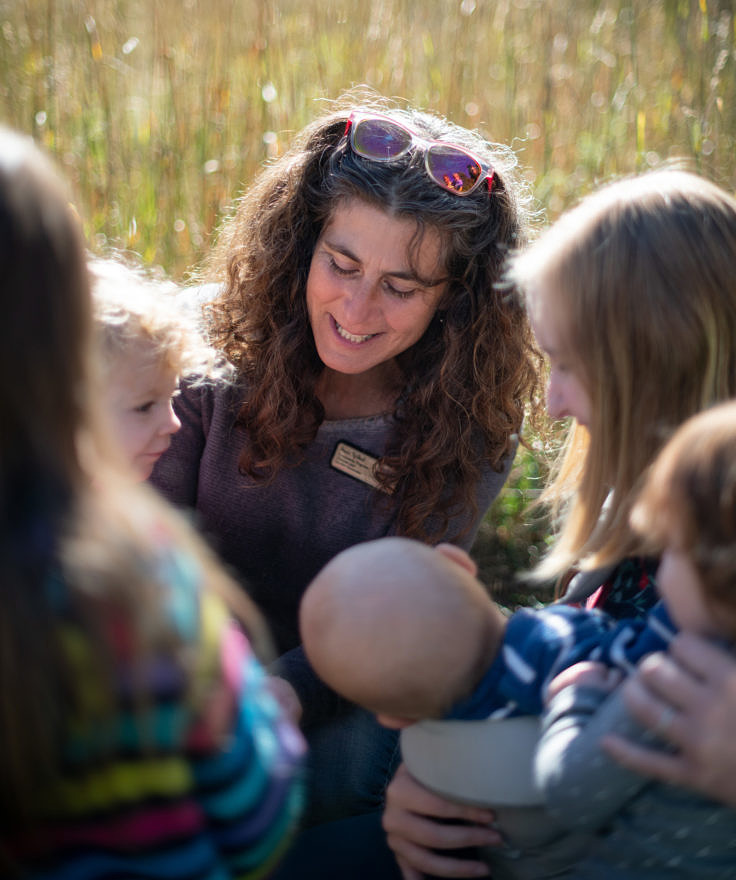
Susie Spikol has spent her life exploring the intersection of nature and story. Growing up in Brooklyn, she searched for fairies and gnomes, enchanted by fireflies and snails — an early love of nature that shaped her 30-year career as a naturalist and educator. She has inspired thousands through hands-on programs and public talks, earning numerous awards for her work.
A regular contributor to Yankee, Northern Woodlands, and Taproot Magazine, she also writes the “Backyard Nature” column for the Monadnock Ledger-Transcript.
Her first book, published in 2022, The Animal Adventurer’s Guide: How to Prowl for Owls, Make Snail Slime, and Catch a Frog Bare-Handed, was recognized with a National Parenting Products Award. Her second book, published in 2025, Forest Magic for Kids: How to Find for Fairies, Make a Secret Fort, and Cook Up an Elfin Picnic is filled with activities inspired by imagination, folklore, and science and an invitation to all readers to step outside and discover the beauty and magic of the world. Her latest book, also published in 2025, The Book of Fairies, takes inspiration from nature, folklore, and her own wild imagination in writing this newest guide to woodland magic


