Meditations on a Marsh
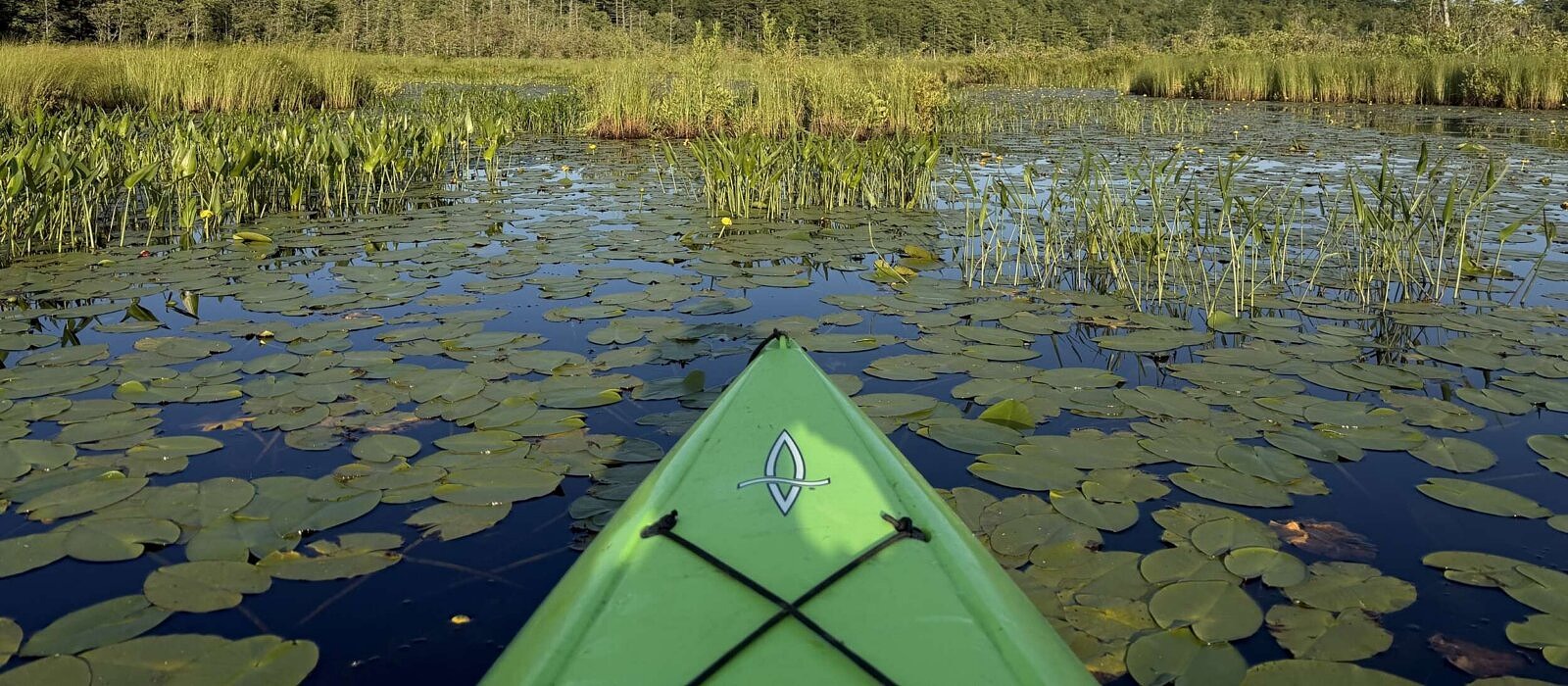
A favorite paddle features a palette of green: watery, pickerelweed-lined channels chock full of a sea of spatterdock. Its promising beginning — deep enough water from which to launch — quickly gives way to an impenetrable wall of aquatic vegetation, seemingly a dead end. My hope of reaching the pond today is perhaps in vain.
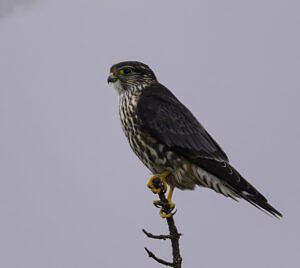
A Merlin surveys the scene. (photo © Chuck Carlson)
It’s August now, and a paddle here in late May when the water is high and the channels aren’t yet vegetated would guarantee success. But, unlike point-to-point trips, this paddle is definitely more about the journey than necessarily reaching the destination at all.
Still, I persist, remaining hopeful for a swim off ‘heron rock.’ I plow through the yellow-flowering lilies, and to my delight, there’s more open water, a wider channel where lilies and milfoil haven’t yet foiled me.
I don’t yet hear the swamp sparrows sing, so I know I need to go farther. The marshy shrublands that rim the pond still lie ahead. Fish dart through wider portions of open water, occasionally drawing my attention with a splash. The channel narrows again, and my destination — one which I do not care to rush — is again called into question. But finally, a wider channel opens, and the roadside still not far behind me, this short paddle already feels like a small adventure.
I turn to admire a wild and conserved viewscape of distant hills, unseen from the nearby road and nearshore black spruce trees growing from a floating bog mat — a mossy and marshy island covered in shrubs and small trees. A sapling tamarack, our only deciduous conifer tree, greets me as I glide past. Or, does it glide past me? Now fully on autopilot, my lily-colored watercraft is at home here, and a wider channel visually leads me to the promised pond.
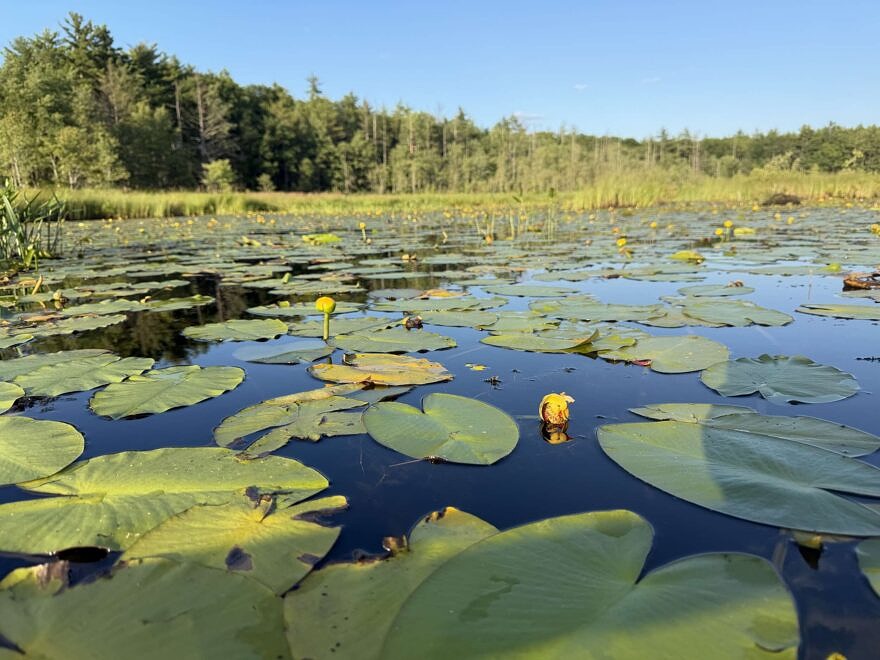
Yellow pond lilies decorate the scene in this local marsh. (photo © Phil Brown)
Ahead, a heron flushes and sails gracefully across the pond to alight on a rock — the rock. It seems that a heron always guards this favored basking spot. I hope to soon swim from that rock, but for the moment, it is fully occupied, so I wait my turn without approaching further.
I still wear binoculars around my neck, but I no longer feel the need to greet every bird with them. By now, the summer birds have become familiar friends, and I choose to simply take in the whole scene. Tuning back to my ears, the chorus of wetland birds never ceases to delight and amaze me, even by late summer — the high, piercing calls of kingbirds, round, rolling songs of yellowthroats, harsh calling redwings, and, of course, the swampies, which ring like old-fashioned telephones from shoreline shrubs.
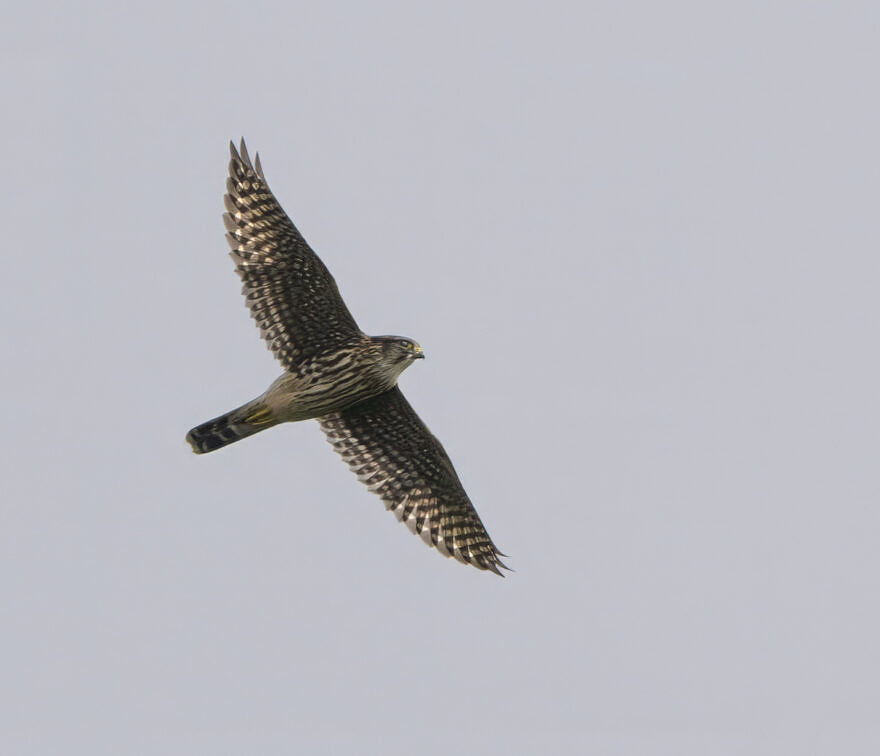
A Merlin takes flight over the marsh. (photo © Chuck Carlson)
In the Kingfisher’s Realm
Kingfishers scold each other, one from the pond and another beyond. Their agitated chatter is incessant, suggesting more than a simple territorial squabble. They mean business. Perhaps a Bald Eagle threatens to make a meal of a youngster, or perhaps it is I who worries them? No doubt the fuss involves their young, now likely free-flying fledglings. Both of the pair (from what I have deemed without seeing the female’s rust-colored belly band) converge overhead to team up on this unseen (to me) threat.
A kingbird chimes in to help defend the monarchy, but this gives away nothing, as this species is notoriously irritable. I force myself not to look. Instead, this evening, I continue to listen and interpret the threat by ear.
When the tree swallows band together in attack mode and the kingbirds finally get organized, and all the marsh is suddenly alive with excitement and terror, I finally can no longer resist a look. I don’t raise binoculars, but I spot it naked-eye over the pine treeline — a dark form with rapid wingbeats, ushering itself out of sight as quickly as it came into view. A Merlin has made a brief appearance, and this is a noteworthy event both for me and the resident songbirds. After a few minutes, the goldfinches once again sing, as do the swampies, signaling no further danger. And still, I haven’t even reached the pond.
The journey already a success, I paddle on, finally reaching the open water — which today might only be a side note. After a time, the heron mercifully relinquishes his rock, and I decide it’s time for my swim. I’ve lingered, and the late-day sun dips behind the western hills. The swim is delicious and the view extraordinary, and though it is late, I savor it. Paddling back, dripping wet and cool with the evening air, I let the deer flies punish my bare back — as they should to protect such rich treasure. Sunset lies ahead, as does civilization.
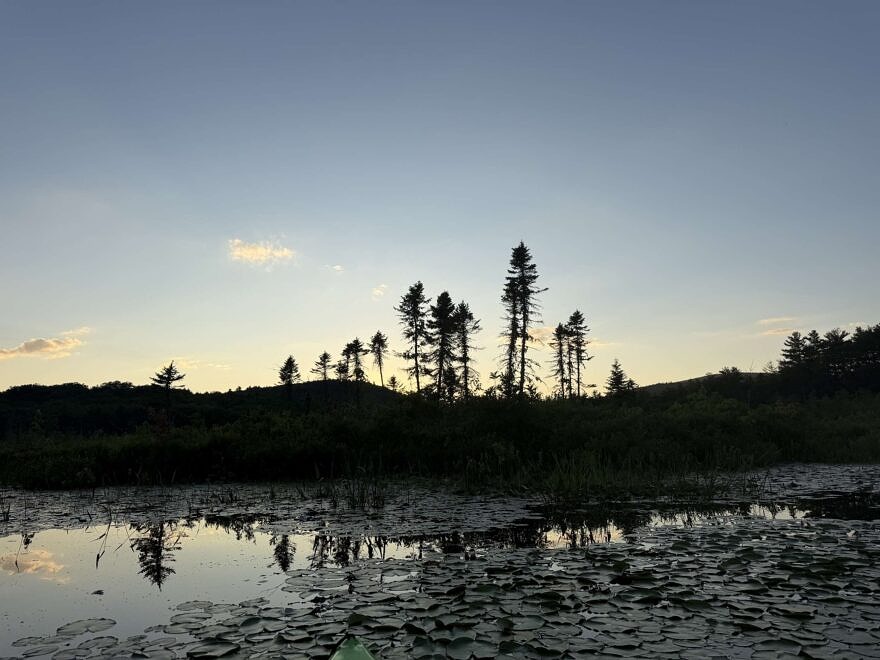
Black spruces stand in the gloaming, taking in the sunset. (photo © Phil Brown)
This story was originally published in the Monadnock Ledger-Transcript on August 25, 2026.
Phil Brown

Phil spent his childhood in Staten Island, New York, where there was just enough green space to help cultivate a deep interest in the natural world, particularly birds. In and after undergraduate studies at Rutgers University, he pursued a career in natural resource management, initially in urban settings. In 2004, he took to the woods of New Hampshire, landing a job as NH Audubon’s Director of Land Management, a position he held for 17 years. Phil first crossed paths with the Harris Center during his time as a graduate student at Antioch University New England in 2007, when he interned as an easement monitor and served as a teaching assistant for Meade Cadot’s final Mammalogy class.
Phil is a frequent field trip leader for the Harris Center and a birding and natural history tour guide for both The Dreamcatchers and Lead with Nature. As the Harris Center’s Bird Conservation Director, he also manages the Pack Monadnock Raptor Observatory and conservation projects related to American Kestrels and Broad-winged Hawks.


