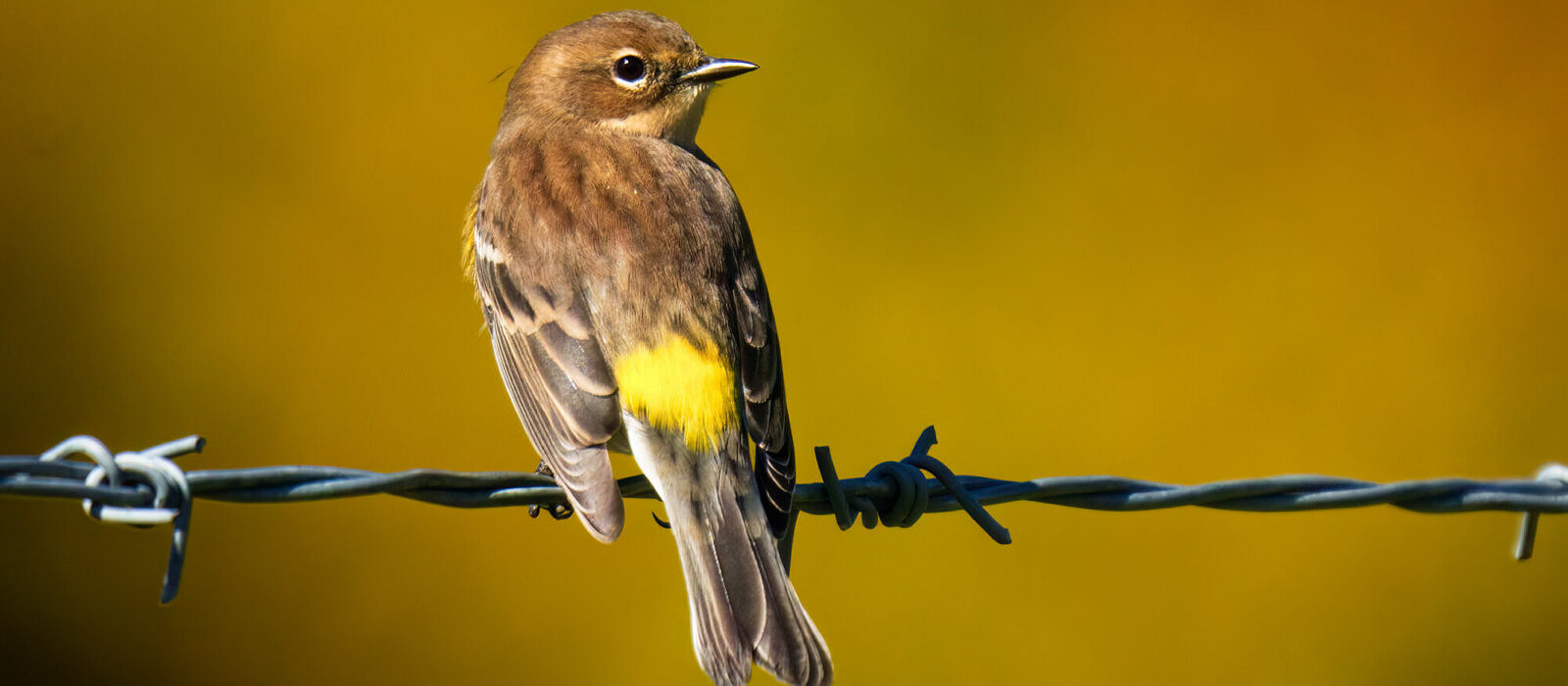
An Unexpected Winter Guest
In December, once we felt reasonably certain that the local black bears had retreated to the coziness of their dens for the season, my husband and I put up our bird feeders. Our setup is simple — a few tube feeders with seed in the side yard, and a couple of suet cages closer to the house — but it brings welcome life and color to these gray winter days.
A nice thing about feeders in winter, especially for still-learning birders like me, is that they attract a small but steady cast of characters, and you can get to know them well. Our yard sees the same ten species every day. You can set your clock on it.
A male Yellow-rumped Warbler at MacDowell Lake in Peterborough, NH, sporting his spring breeding-season plumage. Winter plumage is not quite so flashy. (photo © Chuck Carlson)
One day, though, amidst the juncos and the titmice, the chickadees and the woodpeckers, a different bird appeared. Small and streaky, with butter-yellow side patches, she clung to the suet feeder at our living room window just long enough for me to snap a few photos. “Is it possible,” I wrote to my friend and colleague Nate Marchessault, who patiently entertains all my bothersome bird identification questions, “that there’s a Yellow-rumped Warbler at my suet on December 10?”
In the warmer months, Yellow-rumped Warblers are quite common in New Hampshire. In May and October, clouds of these “butterbutts” can be seen flitting through thickets and spruce forests in search of insects and fruit to fuel their migrations. During the breeding season, they nest in hemlocks and other conifers throughout New England, including here in the Monadnock Region. But winter is another story.
Yellow-rumps typically overwinter in Central America, the Caribbean, the southern United States, and in coastal habitat as far north as Cape Cod. They do not, however, typically overwinter in southwestern New Hampshire.
By early November, most of our warm-weather warblers have already departed for more temperate climes — but, every once in a while, for reasons biologists don’t fully understand, one sticks around.
I dutifully reported our lingering warbler to eBird, grateful that she was frequenting a suet feeder close to a window so I could get verifying photos that showed her distinctive patches. Throughout December and into January, she kept showing up, and I kept reporting her to eBird – half-convinced that each time would be the last.
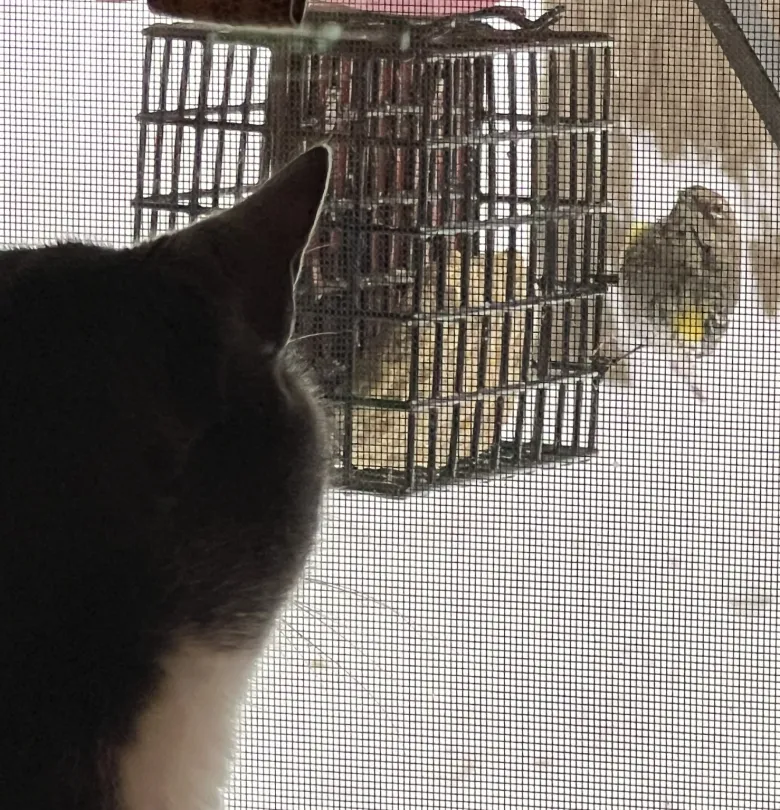
Thelen’s cat Arthur watching the Yellow-rumped warbler through the window in Harrisville (photo © Brett Amy Thelen)
The Warbler’s Out of the Bag
Then, something strange began to happen. An acquaintance I hadn’t seen in years wrote to congratulate me on the warbler. At a retirement party for a biologist friend in Concord, another biologist friend came up to me, unprompted, and said, “Well, you’ve got a Yellow-rumped Warbler in your yard, so life must be good.”
The word was out — and it hadn’t come from me.
I’ve since learned that eBird offers a subscription service of sorts: you enter your county, state, or country of interest, and they will email you daily Rare Bird Alerts for that particular location. I thought I was simply reporting my sightings to the eBird database. Unbeknownst to me, I was also sharing them with every rare bird devotee in the Granite State.
Birders can be an obsessive bunch, and nothing drives that obsession more than seeing a bird in a place it shouldn’t be. In 2022, a Steller’s Sea-Eagle showed up in Maine, thousands of miles from its native Siberia, and thousands of birders followed suit, some from as far away as California. One study estimated that their collective expenditures on food, lodging, airfare, gas, and other travel contributed somewhere between $380,000 and $732,000 to the local economy.
A Long Way From Home
Closer to home, a Rufous Hummingbird ventured far from its West Coast and desert Southwest range last fall, landing at a bird feeder in Stoddard. In December, the birding community caught wind, and the homeowners graciously held visiting hours. (They also installed a heated feeder to sustain the diminutive nectarivore once the mercury began to dip.) Over 60 people added the tiny superstar to their eBird checklists, one commenting, “We drove a long way for this hummingbird.”
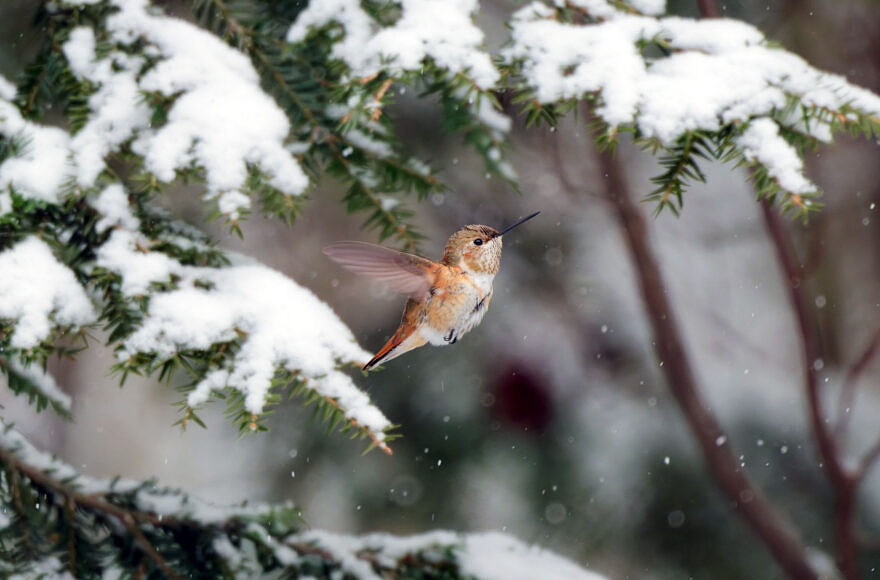
A Rufous Hummingbird is a rare winter visitor to New England. This one was observed in Stoddard, NH in December 2025.
(photo © Leo McKillop / Macauley Library)
The Rufous Hummingbird was last seen dodging snowflakes on December 14, underscoring a sobering reality of these otherwise-exciting occurrences: there tend to be fewer reports of winter rarities once January and February roll around, as prolonged cold and increasing food scarcity likely take their toll on species that have not evolved with winter. There’s a reason all the other hummingbirds spend February in the tropics.
Sometimes, however, these wanderers are more than mere anomalies struggling their way through a harsh winter for the first — and last — time. Sometimes, they’re portents. Thirty years ago, Red-bellied Woodpeckers and Carolina Wrens would have made New Hampshire’s Rare Bird Alert at any time of year, and Eastern Bluebirds were still considered harbingers of spring. Now, thanks to warming winters and the increased presence of bird feeders on the landscape, all three species are common year-round residents of the Monadnock Region.
Weathering an Arctic Blast
Our warbler would frequent our feeder for several days in a row, then disappear for a week or more. Every time, I worried. How was she surviving the bitter cold, especially after dark? Was she huddled overnight in a hollow tree with a band of bluebirds, or shivering alone under a spruce bough? Could she find enough food in the snow-covered woods when she wasn’t subsisting on suet?
The weeklong deep freeze in mid-January was particularly concerning, but after nearly two weeks, she reappeared, bedraggled but feisty. She visited often through the first week of February, and now we’re in another pause, waiting and worrying once again.
Yellow-rumps are a hardy bunch, able to overwinter further north than other warblers in part because they’re the only warblers capable of digesting the wax in coastal bayberries and wax myrtles. The Cornell Lab of Ornithology reports that they occasionally venture as far as Nova Scotia and Newfoundland in the colder months, though they tend to stick close to the berry-rich (and more temperate) coastline.
What then to make of our plucky friend? Is she an avian anomaly, or a sign of things to come? Twenty years from now, will we all have butterbutts at our feeders, elbowing Red-bellied Woodpeckers and other southern ex-pats out of the way? Will heated hummingbird feeders become a backyard fixture, leaving the rare-bird tourism for other species? I guess we’ll just have to wait and see.
This story was originally published in the Monadnock Ledger-Transcript on February 24, 2026.
Brett Amy Thelen

Brett (she/her) has been directing community science programming for more than twenty years. She has an MS in Environmental Studies: Conservation Biology from Antioch University New England and a BA in Literary & Cultural Studies from the College of William and Mary in Williamsburg, VA. Prior to and during her graduate studies, she held a variety of ecological research and environmental education roles with Cape Cod National Seashore.
In addition to her work with the Harris Center, Brett writes for Northern Woodlands and other publications.
In her free time, she can be found roaming the dunes and shores of outer Cape Cod, exploring the springtime desert, or walking the quieter corners of the SuperSanctuary. She lives in Harrisville with her husband, Russ, and their chirpy cat, Arthur.


