Spring is a season of hurrying. Birds rush to begin the swift, serious business of establishing and defending territories, courting, building nests, laying eggs. Salamanders and frogs race toward vernal pools and other wetlands by the thousands on rainy nights, their urgency to mate eclipsing even their need for food. Streams surge, made bold by spring rains.
In their own way, plants hurry too. Nowhere is this more evident than in the spring ephemeral wildflowers, woodland species that sprout, bloom, and set seed all in a month or two — photosynthesizing in the short-lived sunshine before deciduous trees leaf out and cast the forest floor in shade.
The Woods Begin to Awaken
At a time of year when much in the woods is still wearing its drabbest brown and gray, spring ephemerals offer a welcome burst of color — and with names as fanciful as “Gaywings” and “Stinking Benjamin,” they add an imaginative flair to any outdoor adventure. Here are a few to watch for in the coming weeks.
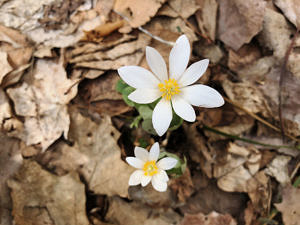
White bloodroot is one of the earliest wildflowers to bloom each spring.
(photo © Brett Amy Thelen)
One of the very first wildflowers to appear each spring is bloodroot, a low-growing flower composed of eight bright white petals surrounding a cluster of golden stamens. The flower and single, distinctively lobed leaf emerge at the same time, with the leaf curving around the stalk like a cloak, offering protection from cold and wind. On overcast days and at night, the flower closes, preserving its pollen for sunnier times, when pollinators are more active. Look for it on hillsides with rich soil, where it often grows in dense colonies.
Trout lilies are named not for their blooms, but for their leaves, which are mottled like the skin of a brook trout. Their flowers are pale yellow and nodding, or downward-facing. Remarkably, only 0.5 percent of the individual plants in a trout lily colony will bloom in any given year, and not until they’re four to seven years old — so, if you find more than a few in flower, consider yourself fortunate! You can tell whether a trout lily will bloom by the number of leaves at its base: non-flowering plants have a single basal leaf, while flowering plants sport two.
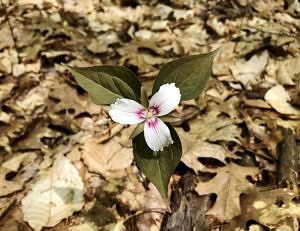
Painted trillium looks as though its petals have been brushed with magenta. (photo © Brett Amy Thelen)
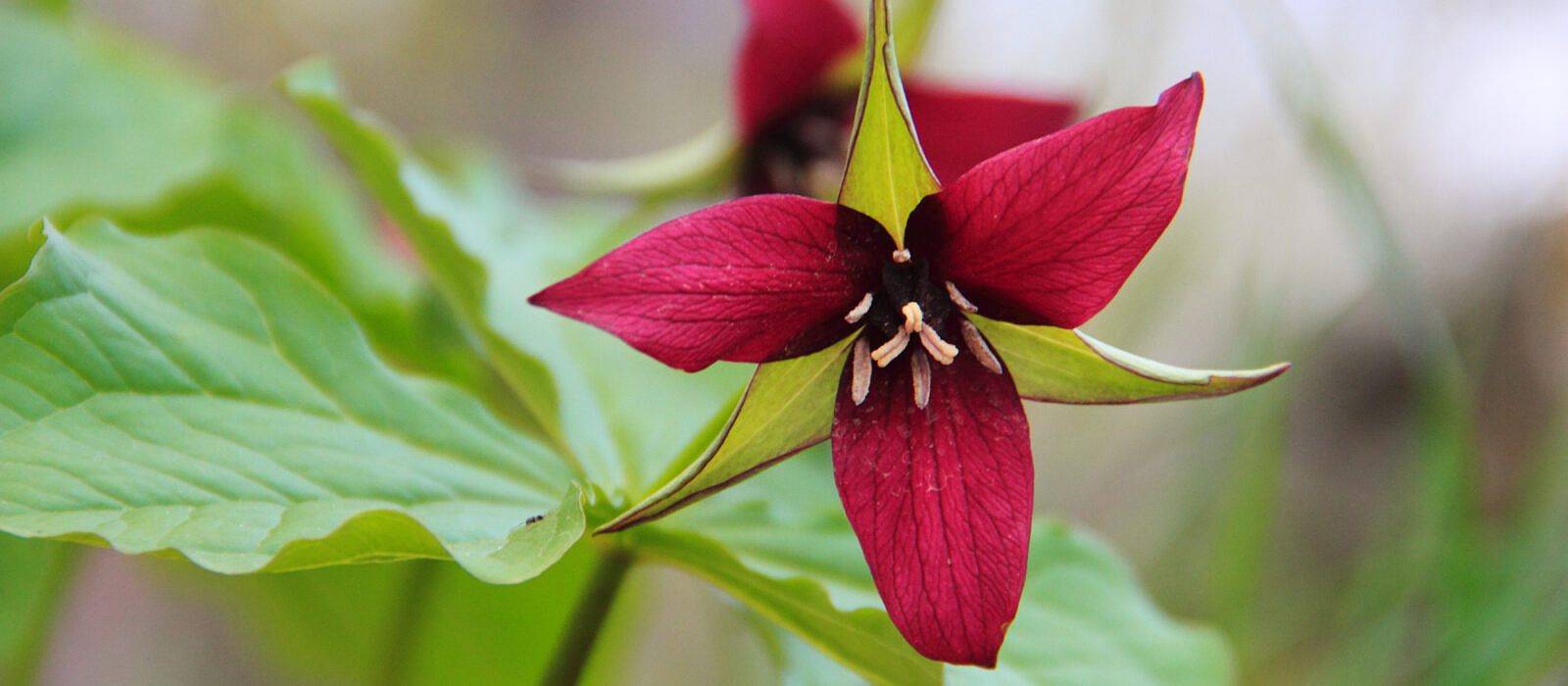
Among the most recognizable and widespread spring blooms is trillium, aptly named for its arrangement in threes: three leaves, three petals, three sepals. The two most common trillium species in our neck of the woods are painted trillium and red trillium, also known as purple trillium, wake-robin, and stinking Benjamin, after the fetid smell that attracts beetles and carrion flies — connoisseurs of rotting meat who get duped into doing double-duty as pollinators. (I have no idea who Benjamin was, or how he came to be remembered so ignominiously.)
Red trillium tend to bloom earlier, and are deep red or purple in color — another attempt at impersonating rotting flesh. They can grow quite large as wildflowers go, with leaves up to 8 inches long, and are often found along stone walls or at the base of deciduous trees. Painted trillium have smaller, narrower white petals with wavy edges and “painted” magenta centers. Both species, scent aside, are beautiful to behold.
Dutchman’s breeches are a rarer treat, growing mostly in rich woodlands near talus slopes or other rocky areas, but they’re hard to mistake for anything else: as their name suggests, they resemble miniature pantaloons hanging on a clothesline. This species is particularly well-adapted for pollination by queen bumblebees, who emerge from their winter hibernation, hungry for pollen and nectar, just as Dutchman’s breeches come into bloom.
Check Out these Ephemeral Hotspots

Look for trout lilies at the top of Butterfield Hill, in TNC’s Warwick Preserve in Westmoreland. (photo © Brett Amy Thelen)
This time of year, nearly any walk in the woods will yield a wildflower or three, but some places are more extravagant than others. For a short Monadnock Region day trip in search of spring ephemerals, head west to the Nature Conservancy’s Warwick Preserve in Westmoreland. This 40-acre property was protected in large part for its wildflower diversity, and a rugged 1.5-mile loop trail offers opportunities to see bloodroot, spring beauty, trailing arbutus, trillium, hepatica, Dutchman’s breeches, and more.
Closer to home, the Harris Center’s Hiroshi land near the Peterborough-Dublin-Harrisville town lines is also a wildflower wonderland. Local naturalist Francie Von Mertens has recorded 17 different wildflower species along the 1.9-mile Hiroshi Loop Trail in the months of April and May alone. You can see photos of some of them — and contribute your own observations — via the Harris Center’s new iNaturalist project for this property.
Wherever you decide to go, don’t wait too long. Like the dawn birdsong chorus and the toad’s lusty trill and all the other hurried joys of spring, woodland wildflowers are a fleeting beauty. Catch them while you can.
This story was originally published in the Monadnock Ledger-Transcript on April 26, 2022.
Brett Amy Thelen

Brett (she/her) has been directing community science programming for more than twenty years. She has an MS in Environmental Studies: Conservation Biology from Antioch University New England and a BA in Literary & Cultural Studies from the College of William and Mary in Williamsburg, VA. Prior to and during her graduate studies, she held a variety of ecological research and environmental education roles with Cape Cod National Seashore.
In addition to her work with the Harris Center, Brett writes for Northern Woodlands and other publications.
In her free time, she can be found roaming the dunes and shores of outer Cape Cod, exploring the springtime desert, or walking the quieter corners of the SuperSanctuary. She lives in Harrisville with her husband, Russ, and their chirpy cat, Arthur.


