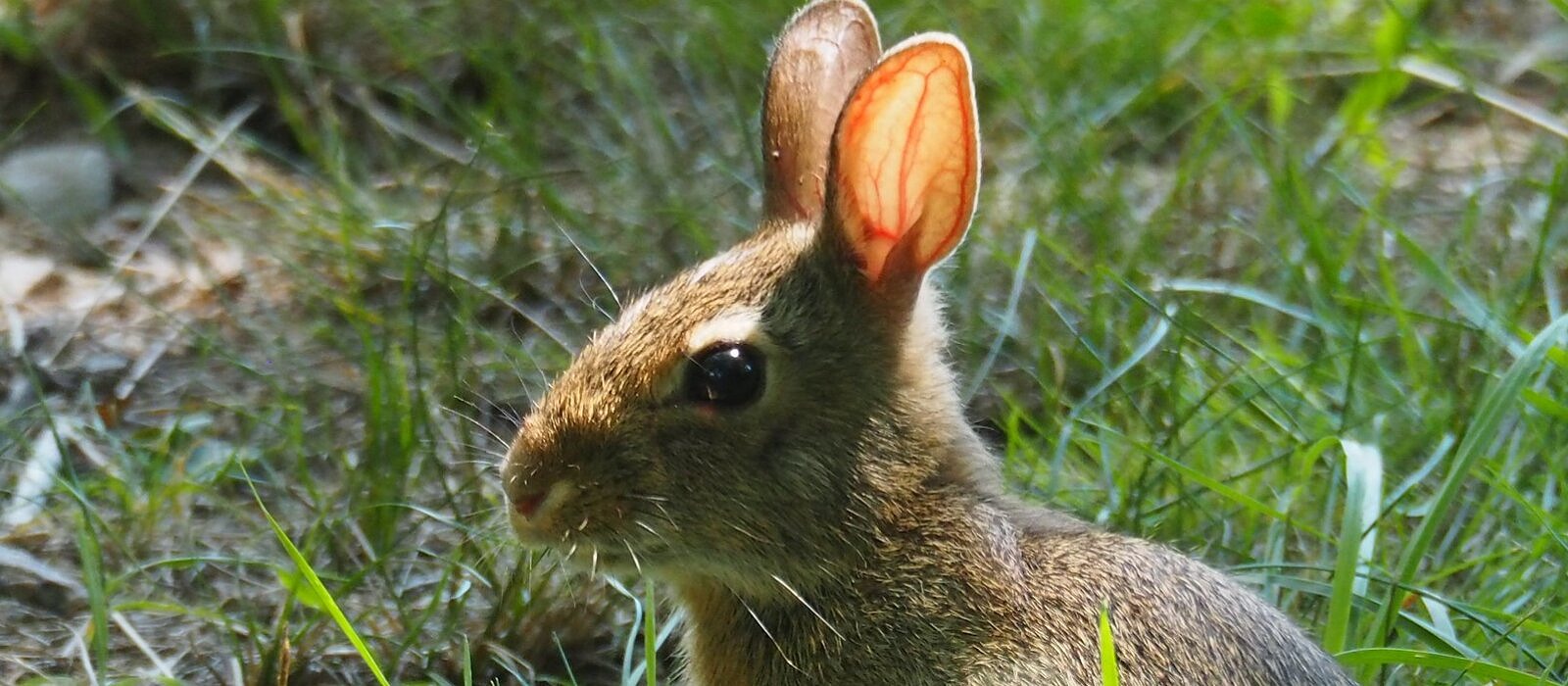
The New England Cottontail
It began last spring with phone calls to the Harris Center, as excited people shared reports of a surprising mammal. I hadn’t seen one yet, but then one day on an early morning bird walk along a Peterborough meadow, I caught my first glimpse. There in the tall grass, chewing on wildflowers, nose and whiskers twitching, sat a rabbit with long ears and a little floof of a tail.
I’ve lived here since 1990 and have seen my fair share of the brilliant white snowshoe hare in the winter, but I had yet to see a small cotton-tailed bunny. And no wonder, since New Hampshire’s native New England cottontail rabbit was listed as one of NH’s endangered species in 2008. Currently, they are only found in a few locations along the Seacoast and in the Merrimack Valley. I had my suspicions that the rabbits we were seeing were something different than the New England cottontail.
New England cottontails are small woodland rabbits, limited to the scrubby shrublands and successional forests of our state. According to Heidi Holman, a wildlife diversity biologist for New Hampshire’s Fish and Game’s Non-Game and Endangered Wildlife Program, “New England cottontail rabbits’ distribution has always been limited by the snowpack line. Historically, these rabbits were associated with New Hampshire’s coastline, where there is less snow.”
Due to habitat loss and fragmentation, the New England cottontail population is estimated to be around 300 individuals in New Hampshire. Studies show that fewer than 10,000 remain in the wild across all of New England. With the loss and fragmentation of dense cover provided by thickets and shrubland habitat, the New England cottontail is highly susceptible to predation. With increased densities of predators, like foxes and coyotes, two carnivores that are comfortable living on the edges of increasing development, the pressure on these rabbits has continued to increase, creating a double whammy for them: decreased habitat and increased predator pressure.
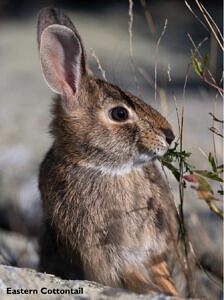
Eastern Cottontail Rabbit on Pack Monadnock. (photo © Chuck_Carlson)
The Eastern Cottontail
The rabbits we are seeing in the Monadnock region are not New England cottontails, but rather Eastern cottontail rabbits. Over the last few years, this rascally rabbit has made itself very comfortable in the southwest corner of New Hampshire. But who are they, where did they come from, and what does it all mean?
New Hampshire wasn’t the original home of the Eastern cottontail. In the early 1900s, this rabbit was introduced into New Hampshire for hunting. State agencies and private game clubs imported rabbits from Missouri, Kansas, and Texas from the 1920s through the 1950s. Before the introduction of the Eastern cottontail to New Hampshire, the only true native rabbit in our state was the New England cottontail, and the one species of hare, the snowshoe hare.
Similar Appearance, Different Needs
At first glance, it is almost impossible to tell New England cottontails from Eastern cottontails. These two genetically distinct species share mottled, brownish-gray fur, long, upright ears, and a comparable tail. They are so similar in appearance that even expert field biologists can have trouble distinguishing them and often rely on DNA samples from scat or fur, or by examining the skull.
Their subtle visual differences are hard to spot. New England cottontails are smaller with smaller ears. They often have a black line on the front edge of their ears and a black spot on their forehead. About 50% of Eastern cottontails have a white star-like spot on their foreheads. These field marks are not always consistent and can be challenging to discern in the field.
The most significant difference between these rabbit species is their habitat preference, and it is this difference that has contributed to the decline of New England cottontails and the population success of Eastern cottontails.
According to Brett Ferry, the Small Game and Pheasant Project Manager for New Hampshire Fish and Game, “Eastern cottontails are not habitat specialists and do well in proximity to people. They use open and shrub habitats but also thrive in backyards and housing developments with plenty of green lawns to eat and a shed or ornamental bush for cover.”
Scientists have attributed the Eastern cottontail’s ability to successfully live in open grasslands to the size of their eyes. With larger eyes, these rabbits spot danger from predators more easily than our native woodland rabbit. The New England cottontail depends on the dense cover of its shrubland habitat to protect it from predators.
Add this habitat flexibility to a decrease in the amount of snowfall due to climate change, and this is a win-win for the Eastern cottontail in New Hampshire. With our decreasing snowpack and milder temperatures, the Eastern cottontail winter survival rate is increasing, and these bunnies are hippity-hopping into the meadows, fields, golf courses, yards, and grassy green spaces across the Monadnock region.
Researchers are hard at work trying to save the New England cottontail from the brink of disaster. The shrubs and thickets found in early successional forests that these rabbits need end up being not only essential for cottontails, but also for other species. Over 100 species depend on this type of landscape, including American woodcock, ruffed grouse, and various songbirds such as indigo buntings and eastern towhees.
How You Can Help the New England Cottontail
To find out more about how you can help protect and manage your property for this essential habitat type in New Hampshire, reach out to UNH Cooperative Extension, New Hampshire Fish and Game, or your local conservation organization.
You can help researchers keep track of New Hampshire’s changing rabbit population by participating in the University of NH’s citizen science project, NH Rabbit Reports at nhrabbitreports.org. Upload your rabbit photos, including location and date, to the website. This will help scientists track and understand the changing dynamics of the rabbit population in our state.
This story was originally published in the Monadnock Ledger-Transcript on June 26, 2025.
Susie Spikol

Susie Spikol has spent her life exploring the intersection of nature and story. Growing up in Brooklyn, she searched for fairies and gnomes, enchanted by fireflies and snails — an early love of nature that shaped her 30-year career as a naturalist and educator. She has inspired thousands through hands-on programs and public talks, earning numerous awards for her work.
A regular contributor to Yankee, Northern Woodlands, and Taproot Magazine, she also writes the “Backyard Nature” column for the Monadnock Ledger-Transcript.
Her first book, published in 2022, The Animal Adventurer’s Guide: How to Prowl for Owls, Make Snail Slime, and Catch a Frog Bare-Handed, was recognized with a National Parenting Products Award. Her second book, published in 2025, Forest Magic for Kids: How to Find for Fairies, Make a Secret Fort, and Cook Up an Elfin Picnic is filled with activities inspired by imagination, folklore, and science and an invitation to all readers to step outside and discover the beauty and magic of the world. Her latest book, also published in 2025, The Book of Fairies, takes inspiration from nature, folklore, and her own wild imagination in writing this newest guide to woodland magic


