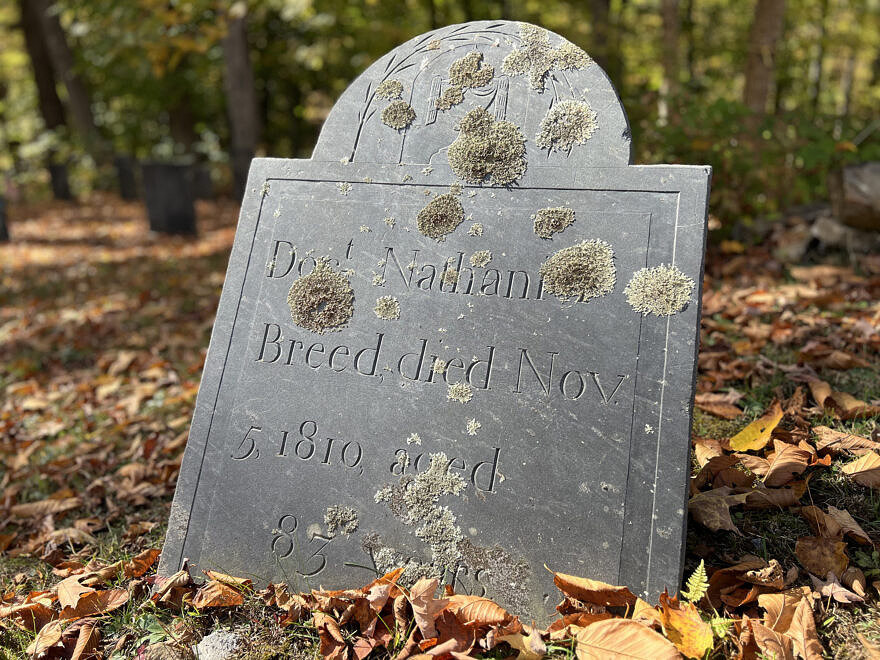
Lichen grows on a gravestone in the Nelson Cemetery, which was established in the early 1800s. (photo © Brett Amy Thelen)
Stories in Stone
Growing up, I was fascinated by history – not the accounts of wars or presidents or politics that could be found in textbooks, but the everyday history of everyday lives. How did people live? What did they long for? What did they fear?
When I was in the fifth grade, my teacher took our class on a field trip to a historic cemetery, and it was a revelation. Until then, I’d only seen the modern cemeteries where my great-grandparents were buried — sterile and straight-lined, with highly manicured lawns. This was entirely different. The ground was mossy and uneven, the headstones worn, weathered, tilting every which way. Some of the gravestones were etched with symbols ranging from the romantic (willow trees, cherubs, clasped hands) to the macabre (winged skulls, crossed bones). If you looked carefully, you could decipher stories in those stones.
Since that time, I’ve visited dozens of old graveyards from Princeton to Paris, including many here in the Monadnock Region.
Although our local cemeteries host their fair share of noteworthy residents — Amos Fortune, May Sarton, Willa Cather — I still find myself drawn to the everyday stories.
The crushing sorrow of the Kittridge family, buried in the Nelson Cemetery, who lost three children aged eight months to eight years in the span of two weeks in August 1848.
The industrious resignation of Fanney B. Goodnow, laid to rest in Harrisville in 1897, whose epitaph reads, simply, “She hath done what she could.”
The I’m-only-human 19th-century memorial mason who had to use a caret and half-point font to insert an overlooked word into an epitaph in Surry.
Cemeteries as Refuge
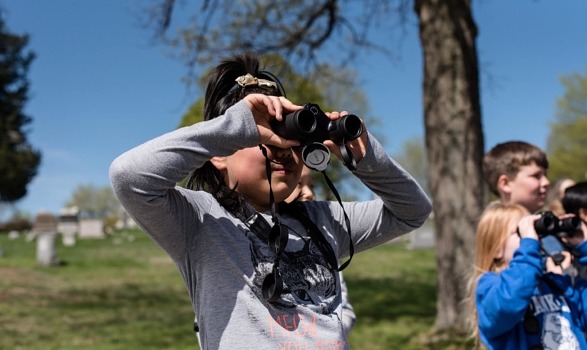
Elementary school students look for birds on a Harris Center-led field trip to the Woodland Cemetery in Keene. (photo © Ben Conant)
Over the years, I’ve come to appreciate old cemeteries as places not just of human history, but of natural history as well. The first time I ever saw an Eastern box turtle, it was plodding its way through an 18th-century burial ground wedged among the narrow streets of a Cape Cod fishing village. Every spring, I spy my first woodcock of the season twittering exuberantly above Woodland Cemetery in Keene; visitors and volunteers to the North Lincoln Street amphibian crossing site can also attest that Woodland is positively hopping with frog activity on rainy evenings in March and April.
In cities, old cemeteries serve as islands of habitat for both migratory and year-round wildlife — more removed from the hustle and bustle of humanity than the public parks that have been designated as “open space.” Nighttime quiet offers protection for nocturnal species such as coyote and fox. Mature trees provide places for birds to rest and nest.
During spring migration, the Mount Auburn Cemetery in Cambridge, Massachusetts opens an hour ahead of schedule for early birders, and a chalkboard at the main entrance includes a list of recent bird sightings. In 2002, it was officially designated as an Important Bird Area by Mass Audubon.
Here in the Monadnock Region, local birders flock to Woodland and Greenlawn Cemeteries in Keene, where an impressive 144 species have been documented via eBird.
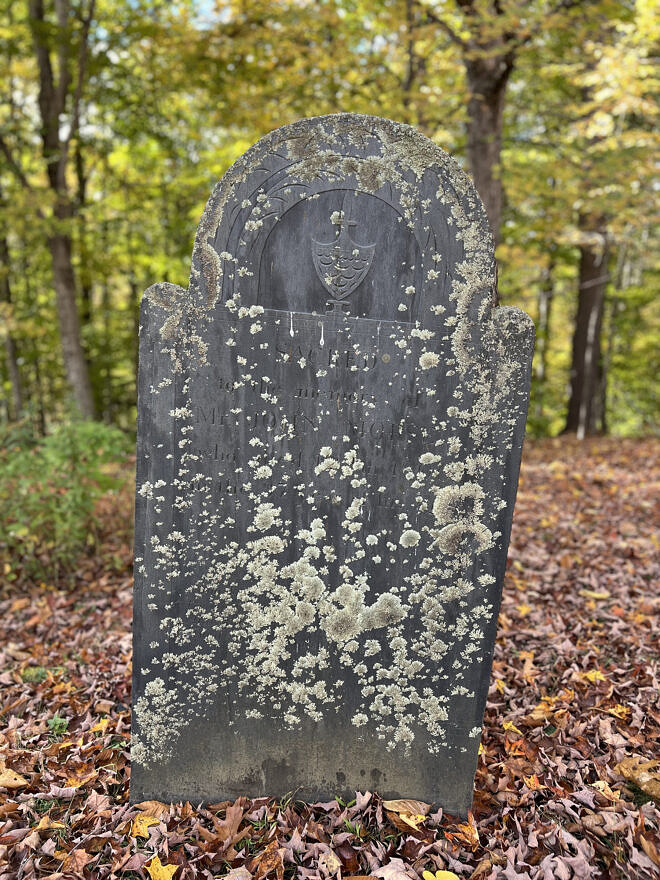
The British Lichen Society estimates that some individual lichens may be almost as old as the gravestones upon which they live, and has declared churchyards “of supreme importance for lichen conservation.”
(photo © Brett Amy Thelen)
The slow pace of change in old cemeteries also suits species that prize stillness. “If something stays still for long enough,” writes Kay Hurley in Lichenpedia, “some kind of lichen will grow on it.” It is perhaps not surprising, then, that more than 700 species of lichen have been documented in United Kingdom churchyards and graveyards, including some found nowhere else. The British Lichen Society estimates that some individual lichens may be almost as old as the gravestones upon which they live, and has declared churchyards “of supreme importance for lichen conservation.”
According to a 2019 literature review published in Global Ecology and Conservation, which examined 97 studies of biodiversity in graveyards and churchyards spanning 22 countries on five continents, cemeteries serve as important refuges not only for lichens, but also for mosses, mushrooms, orchids, medicinal plants, beetles, nesting birds, and old trees.
Across Illinois, remnants of tallgrass prairie — one of the most endangered grassland habitats in the world — hold fast in “pioneer cemeteries,” small plots of land originally set aside as family burial grounds. In an article for Erigenia: The Journal of the Illinois Native Plant Society, landscape architect Domenico D’Alessandro relays the history of one 0.5-hectare site: “Short Pioneer Cemetery Prairie was surrounded by strip mining operations for coal that changed forever the hydrology and topography of the region. This place and its plants survived because they were on sacred ground that even the powerful mining companies would not disturb… In 1988, when [it] was designated as a nature preserve the sacred status did not change.”
In cemeteries, the sacred human and sacred more-than-human worlds find common ground.
Although I will happily explore an old graveyard at any time of year, I tend to seek them out in autumn, when I feel the passage of time more keenly. For me, there’s a peace that comes from wandering among the stones, reading the old names and remembrances rimmed in lichen, hearing the crunch of leaves underfoot and the flutter of wings overhead — and knowing that, even as I am among the dead, I am also among the living.
This story was originally published in the Monadnock Ledger-Transcript on October 25, 2024.
Brett Amy Thelen

Brett (she/her) has been directing community science programming for more than twenty years. She has an MS in Environmental Studies: Conservation Biology from Antioch University New England and a BA in Literary & Cultural Studies from the College of William and Mary in Williamsburg, VA. Prior to and during her graduate studies, she held a variety of ecological research and environmental education roles with Cape Cod National Seashore.
In addition to her work with the Harris Center, Brett writes for Northern Woodlands and other publications.
In her free time, she can be found roaming the dunes and shores of outer Cape Cod, exploring the springtime desert, or walking the quieter corners of the SuperSanctuary. She lives in Harrisville with her husband, Russ, and their chirpy cat, Arthur.


