Spring is in the air. Look around. Do you see the maple sugaring taps? Have you heard the throaty “Okaree” call of the recently returned red-winged blackbird or the wild monkey-like calls of courting barred owls? The ground is softening, the roads are posted, sugar shacks are smoking, and mud season is in full swing. Soon, salamanders will migrate to vernal pools, and the wetlands will be filled with the lusty calls of wood frogs and spring peepers.
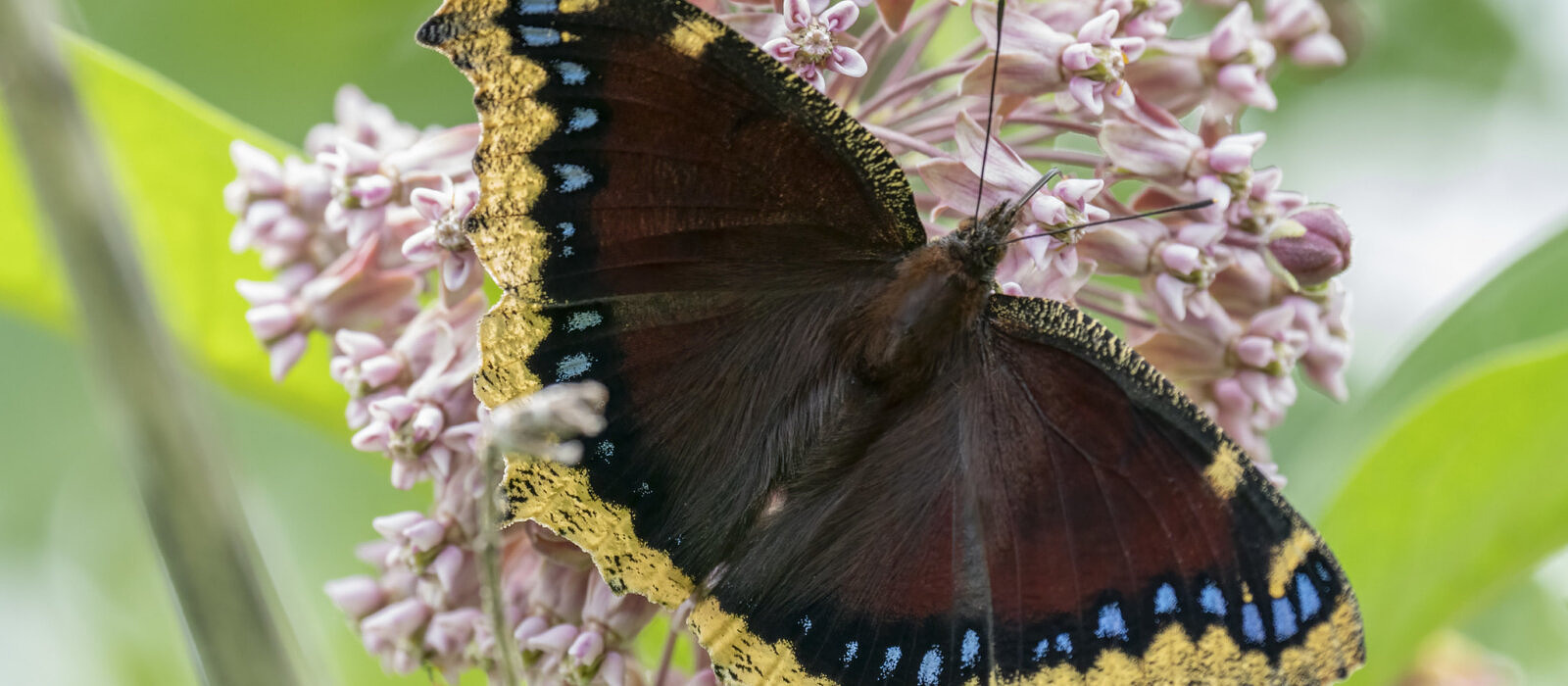
But did you know that one of the earliest signs of spring is the appearance of a dainty woodland butterfly? The mourning cloak is a chocolatey brown butterfly with yellow scalloped edges and a line of blue jewel-like spots. Named after the traditional dark cloak worn when mourning, look for this butterfly when snow still dots the landscape and the forests are bare. With its quick wing beats and slow lilting glides, this hardy beauty is like a floating flower, a brush of beauty during the browns of early spring.
Most butterflies survive winter as eggs or partly grown larvae. While others hibernate through winter, cozily protected inside their chrysalis, and some migrate huge distances to warmer climes like the charismatic monarch butterfly.
Biochemical Superpower
But the mourning cloak is one of New Hampshire’s only butterflies that overwinter as an adult. Tucked inside tight crevices, like tree bark, cracked rocks, house clapboards, and buried under leaf piles, this delicate-winged butterfly has a biochemical superpower. It produces an anti-freeze composed mainly of glycerol, a type of sugar, and other compounds enabling it to withstand temperatures as low as 80 degrees below zero. The anti-freeze solution works similar to how it works in a car system; by lowering the temperature at which water freezes, ice is prevented from forming and causing irreparable damage inside the cells of this butterfly.
When the sap begins to run, the mourning cloak emerges from its protected shelter, searching for food and mates. With its early emergence and the lack of blooming flowers, it relies on tree sap and rotting vegetation. Wounds in trees made by woodpeckers allow the mourning cloak to siphon up the sugary liquid. Look for this butterfly walking headfirst down oak trees, searching for its preferred sap. You will have to look carefully, for when the mourning cloak has its wings folded up, the beautiful rich chocolate color with its creamy yellow edge and spectacular blue dots are hidden. Instead, it resembles a non-descript fleck of charred bark with a ragged, dull-white band.
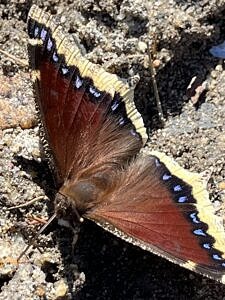
photo © Mark Ellingwood
Spring is fickle in New England, with its warm sunny temperatures one day and snowstorms the next. Lucky for the mourning cloak, it can slip back into its winter den when April suddenly feels like February. But on warm days, watch for the mourning cloak basking on branches with its dark velvety wings wide open, acting like solar collectors, drawing in the heat of the early spring sun. As spring becomes more predictable, territorial males perch on branches waiting for receptive females.
A Long-lived Species
Mourning cloaks are long-lived butterflies, living for about ten months. But after mating, the mourning cloak dies. Pale yellow eggs are found in clusters around host plants, including willow, elm, poplar, birch, and aspen. When the eggs hatch, the spikey black and white caterpillars with rusty orange patches feed voraciously on the host plants. As young caterpillars, they live communally within silken webs, and when threatened, they twitch in unison—a tactic suspected to deter predators.
When June and July have arrived, the mourning cloak butterfly emerges, transformed from caterpillar to adult. It continues to feed on sap and rotting vegetation but will also nectar on some plants, including knapweed. During the heat of summer, the mourning cloak takes a break from the action and estivates—which means to go dormant during prolonged heat. As autumn comes and temperatures cool down, it reemerges and resumes feeding, packing on the fat reserves it will need to make it through the winter, and the whole story begins again.
Become a butterfly watcher this spring. Search for the mourning cloak along dirt roads and watch as they dip and flutter in the mud, feeding on minerals and nutrients. Look for them with their lush wings, and sky-blue spots stretched open in the early spring sunlight. And if you fall in love with this butterfly, as I have, then think what you can do for the mourning cloak and all the butterflies of New Hampshire.
Consider letting your little piece of the world become a refuge for caterpillars and butterflies. It can be as simple as allowing your leaves to pile up in the autumn and waiting a bit before you rake them up in the spring. This ground cover is an essential winter refuge for caterpillars, butterflies, and a thousand other small important creatures. For more ideas on how to help butterflies and other invertebrates, visit the Xerces Society’s website at www.xerces.org.
This story was originally published in the Monadnock Ledger-Transcript on March 24, 2022.
Susie Spikol
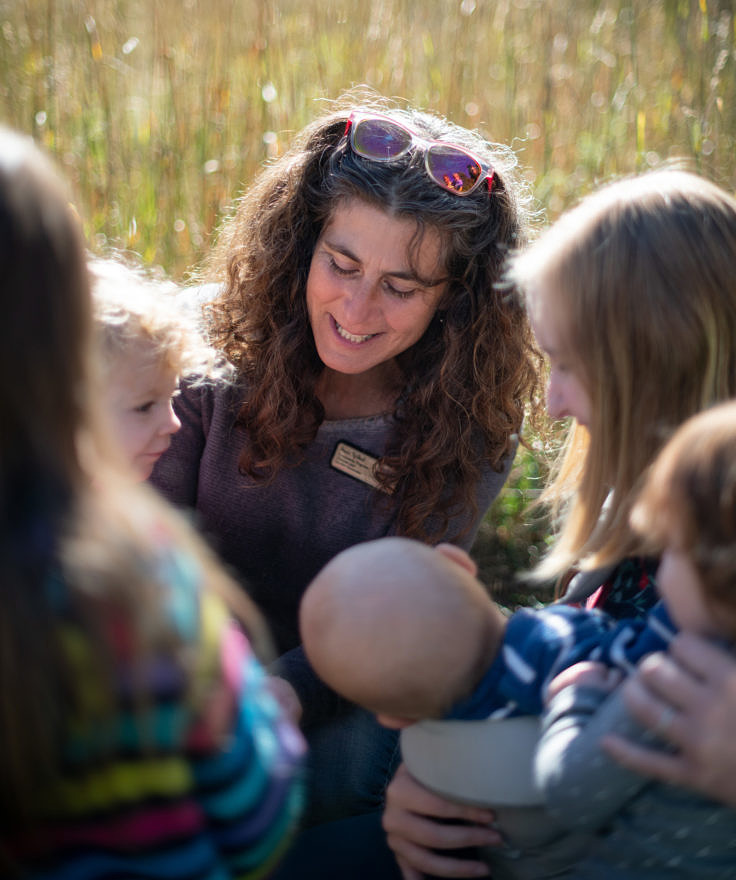
Susie Spikol has spent her life exploring the intersection of nature and story. Growing up in Brooklyn, she searched for fairies and gnomes, enchanted by fireflies and snails — an early love of nature that shaped her 30-year career as a naturalist and educator. She has inspired thousands through hands-on programs and public talks, earning numerous awards for her work.
A regular contributor to Yankee, Northern Woodlands, and Taproot Magazine, she also writes the “Backyard Nature” column for the Monadnock Ledger-Transcript.
Her first book, published in 2022, The Animal Adventurer’s Guide: How to Prowl for Owls, Make Snail Slime, and Catch a Frog Bare-Handed, was recognized with a National Parenting Products Award. Her second book, published in 2025, Forest Magic for Kids: How to Find for Fairies, Make a Secret Fort, and Cook Up an Elfin Picnic is filled with activities inspired by imagination, folklore, and science and an invitation to all readers to step outside and discover the beauty and magic of the world. Her latest book, also published in 2025, The Book of Fairies, takes inspiration from nature, folklore, and her own wild imagination in writing this newest guide to woodland magic


