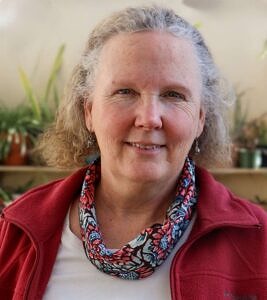
Catherine Owen Koning
Catherine Owen Koning retired as Professor of Environmental Science from Franklin Pierce University in Rindge, New Hampshire, after 33 years of service. She received her B.A. in Biology and Environmental Studies from Bowdoin College, her M.S. in Ecology from the University of California at Davis, and her Ph.D. in Environmental Studies/Land Resources from the University of Wisconsin.
Dr. Koning’s specific area of expertise is wetland science. The courses she has taught include environmental science, wetland ecology, water resources, conservation biology and sustainability. Her research focused on wetland ecology and hydrology, water quality management, and invasive plant species. She has published a book about wetlands, Wading Right In: Discovering the Nature of Wetlands (University of Chicago Press) and has recently co-authored an online open-access free textbook for undergraduates, entitled Saving Biodiversity in a time of Climate Change.
On the Franklin Pierce campus, she helped initiate and coordinate the Institute for Climate Action as well as other sustainability-focused programs. She currently serves on the board of the Monadnock Sustainability Hub, and is an alternate on the City of Keene Energy and Climate Committee. She has also served on the Board of the New Hampshire Association of Natural Resource Scientists and the Society of Wetlands Scientists. In addition, Dr. Koning was a member of the Peterborough Conservation Commission for 8 years before moving to Keene, where she now lives with her husband Rob, child Lynx, and 1 dog and 2 cats. She is an avid gardener, birdwatcher, botanist, hiker, and writer, and aspires to do more artwork during retirement.
Since moving to the Monadnock Region in 1993, Dr. Koning has been very well-acquainted with the work of the Harris Center, and as the organization has grown in its mission and scope, her admiration has similarly expanded. All components of the Harris Center’s mission are near and dear to her heart, from land conservation, nature-centered education, and community science to real-world conservation and stewardship projects — each is critical to the health and well-being of our region’s ecosystems. She is honored to join the Board of Trustees and looks forward to applying her knowledge and talents to further the Harris Center’s mission.


