A BioBlitz Leads to an Exciting Discovery
On April 27, 2026, while participating in the Monadnock Region City Nature Challenge BioBlitz, I happened upon something I had not been searching for. While scrambling along the base of a cliff looking for an unusual fern, I saw a vulture flying out of a small cave. Short-tailed with silvery wing-tips, it was clear this was not just any vulture, but a Black Vulture. Knowing that Black Vultures had not yet been documented breeding in our state, I decided to investigate the cave. What I found inside made my heart jump: two white eggs mottled with brown sitting upon a barely-constructed nest. I excitedly took a few photos to document the nest, then left the area so as not to disturb the birds.
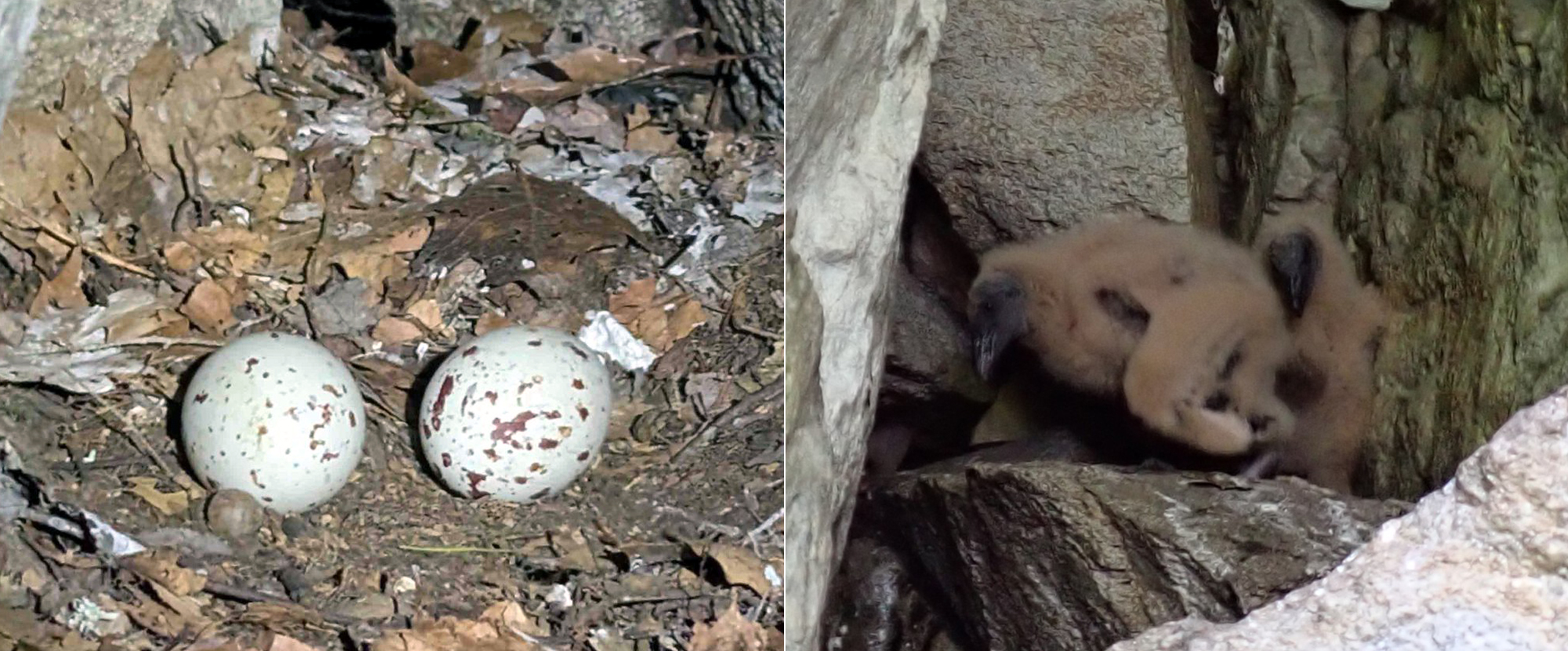
The first documented Black Vulture nest in New Hampshire.
(egg photo © Nate Marchessault; chick photo © Steven Lamonde)
Following this observation, I checked the nest every one to two weeks with biologist (and Harris Center trustee) Steven Lamonde. As with other birds, nesting is a sensitive time of year for vultures, and so nest checks were infrequent, brief, and done in a way to minimize disturbance.
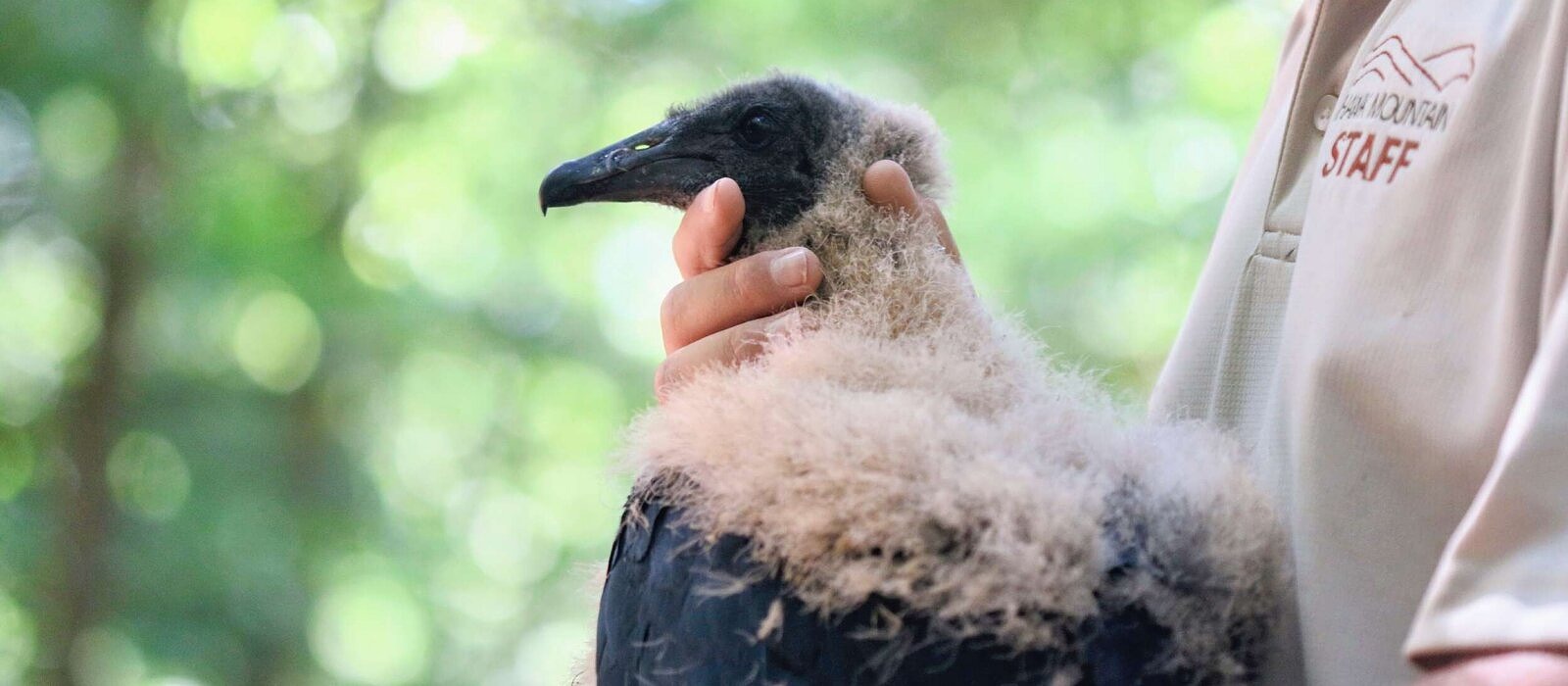
On June 29, Steven first observed the recently hatched chicks, which were covered in yellow-ish down feathers and sporting their characteristic black heads, a kind of vulture-ugly that actually somehow passes as cute.
An Opportunity for Innovative Raptor Research
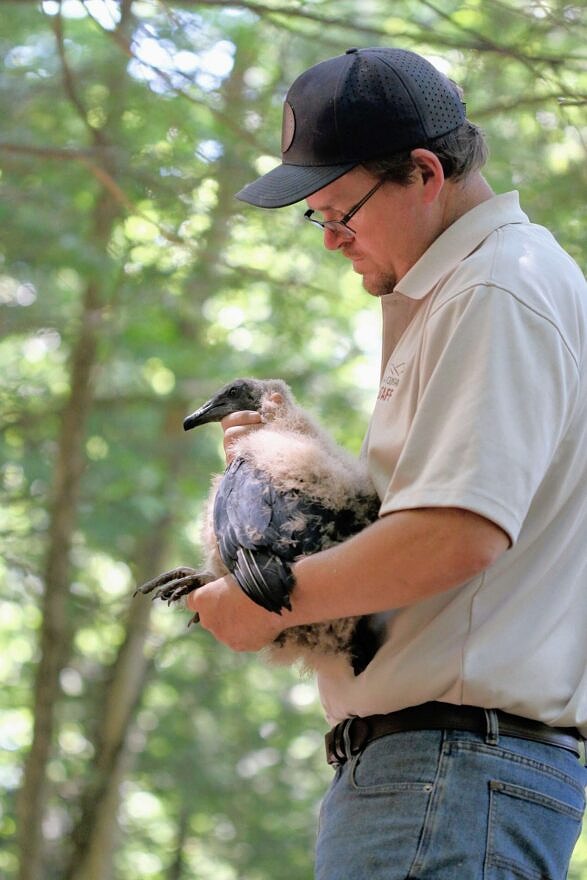
Hawk Mountain Sanctuary biologist Bracken Brown prepares to process one of the young Black Vultures. (photo © Nate Marchessault)
In conjunction with these monitoring efforts, Harris Center bird conservation director Phil Brown was also communicating with Hawk Mountain Sanctuary, a global raptor conservation organization based out of the renowned Hawk Watch in Pennsylvania.
Hawk Mountain is involved in many raptor research projects, and is specifically interested in learning more about Black Vulture breeding and movements in northern New England. Black Vultures are relatively recent inhabitants of our area, with sightings in New England beginning only about 30 years ago; there are currently only a few locations in New Hampshire where they can reliably be found.
Black Vultures are non-migratory throughout most of their range, but the birds in central and southern New England have been observed migrating short distances, and virtually nothing is known about the migratory habits of this species in northern New England.
And so, in late July, Hawk Mountain biologists David Barber and Bracken Brown made the long trek up from Pennsylvania in the hopes of banding both vulture chicks and applying a GPS transmitter to one of them – both ways of collecting useful information on the birds’ movements after they fledged. After skillfully removing the birds from the nest, Bracken and David took measurements such as weight and wing length, and “banded” the chicks.
Unlike other birds, which are typically banded on their legs, vultures are tagged on their wings. This is because vultures engage in a behavior called urihidrosis, or urinating on their legs in order to cool down, and so applying a leg band can result in infections. Instead, a large, colored tag is applied to a thin membrane in the bird’s wing, similar to ear piercing in humans.
In a process that took just a few minutes, the first known Black Vulture chicks in New Hampshire would now be identifiable as individuals: Yellow Tags 502 and 503. These brightly-colored wing tags are large enough to be seen from a distance through binoculars or a spotting scope, and are visible both when the birds are in flight and at rest.
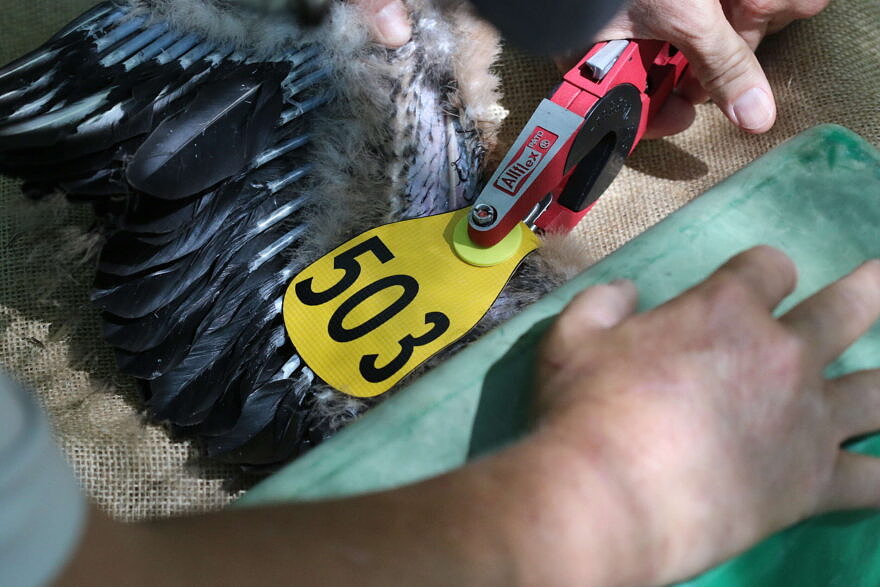
The tag is applied to a thin membrane in the wing, in a process similar to an ear piercing. During the tagging, the rest of the bird’s body is kept in a dark, contained space, which helps to keep the bird calm while the researcher places the button in an area that avoids impacting wing function.
(photo © Nate Marchessault)
In addition to the wing tags, a solar-powered GPS transmitter was affixed to Black Vulture 502. In contrast to the wing tags, which provide information about individual sightings at specific places and times, the GPS transmitter will provide continual, precise location data as long as the battery is charged.
At the time of this writing, the Black Vulture chicks are due to fledge, leave the nests, and take their first flights any day now. Vulture chicks typically remain close to their parents for several months, continuing to beg for food as the parents show them where to forage and roost and the chicks learn to navigate the world on their own.
Black Vultures are also highly social birds that maintain family bonds, so the relationships these chicks have formed with their parents will continue well beyond this first summer. This prolonged parental care period has a lasting impact: Hawk Mountain’s tagging project shows a 78% survival rate for vulture chicks in their first season, much higher than raptor species that have to learn to hunt for themselves after they leave the nest.
Watching and Waiting…
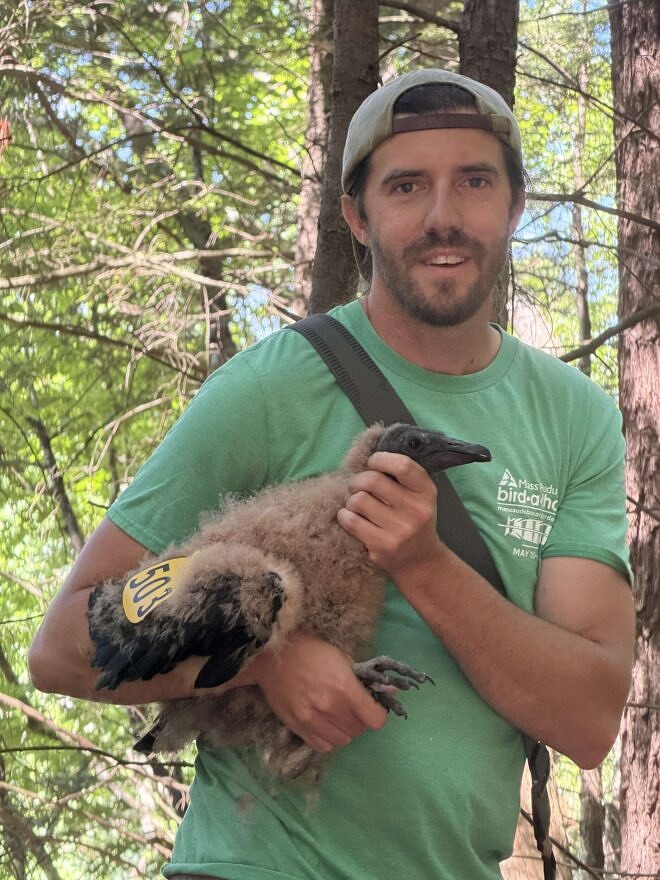
Harris Center ecologist Nate Marchessault holds (gently restrains) Black Vulture 503 during processing. Note: the bird in this photo was handled for research purposes under appropriate state and federal permits. (photo © Phil Brown)
Now that the tags and a GPS transmitter have been deployed, the only thing left to do is wait. In the coming months, I will be checking eBird habitually to look for reports of Black Vultures 502 and 503.
Every day at the Pack Monadnock Hawk Watch, I will wonder if one might soar by. Regardless of whether we see them – or not – the GPS transmitter will provide us with updates on where these birds are headed.
The story of Black Vultures 502 and 503 is more than just the story of two young birds. Their movements will help us better understand the behaviors of Black Vultures in northern New England, where their presence is fairly new and poorly understood. As vultures continue to expand their range northward, observations like these provide an important glimpse into how wildlife respond to a changing landscape. For now, we get to watch and wait, and hopefully keep learning from these two remarkable birds as they begin their lives beyond the nest.
If you spot a tagged vulture, please note the tag color, code, and the location where you encountered the bird, and report that information directly to Hawk Mountain’s New World Vulture project or to the federal Bird Banding Lab portal at reportband.gov. This way, your sighting will become data that can help fill information gaps on our local scavengers!
— Nate Marchessault, Staff Ecologist


