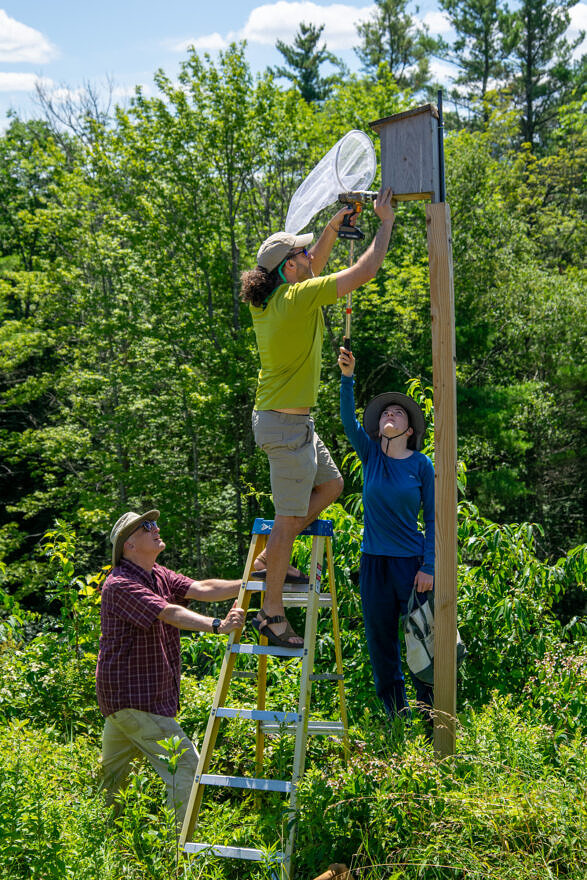
The Harris Center now manages 49 nest boxes across 20 towns. Boxes are mounted on a ten-foot post with a predator-proof sliding pole for safe, easy monitoring. (photo © Corwin Levi)
The Project’s Beginnings
In 2022, the Harris Center launched a project aimed at conserving America’s smallest falcon, the American Kestrel, a species of special concern in New Hampshire.
Having declined over 60% since the 1960s, kestrels are no longer a familiar sight across farm fields and open landscapes. These “secondary cavity nesters” can’t create their own nest holes, instead relying on old woodpecker cavities, utility poles, or openings in barns and silos. In the Northeast, many farms have been developed or reverted to forest, and remaining fields often lack cavity trees in suitable locations. Kestrels also face added pressures from declining insect populations, shifting agricultural practices, and a growing human footprint.
Kestrels still persist in strongholds along major river valleys and large agricultural areas, but even there, populations have declined. For over 50 years, biologist Steve Wheeler has tracked and managed kestrels across New Hampshire, on his own and often at his own expense, through a statewide nest box program on private lands. Until recently, however, southwestern New Hampshire had received little attention. The Harris Center’s kestrel conservation project set out to change that.
With a “build it and they will come” mindset, we raised funds for materials, recruited volunteers to build nest boxes, and partnered with landowners of large fields and farms. Guided by a GIS-based habitat model developed by former bird conservation intern and Antioch University graduate student Will Stollsteimer, we targeted the best potential habitats — primarily hayfields and pastures of 15 acres or more. Staff and interns mounted each box on a ten-foot post with a predator-proof sliding pole for safe, easy monitoring. Three years later, the Harris Center now manages 49 nest boxes across 20 towns.
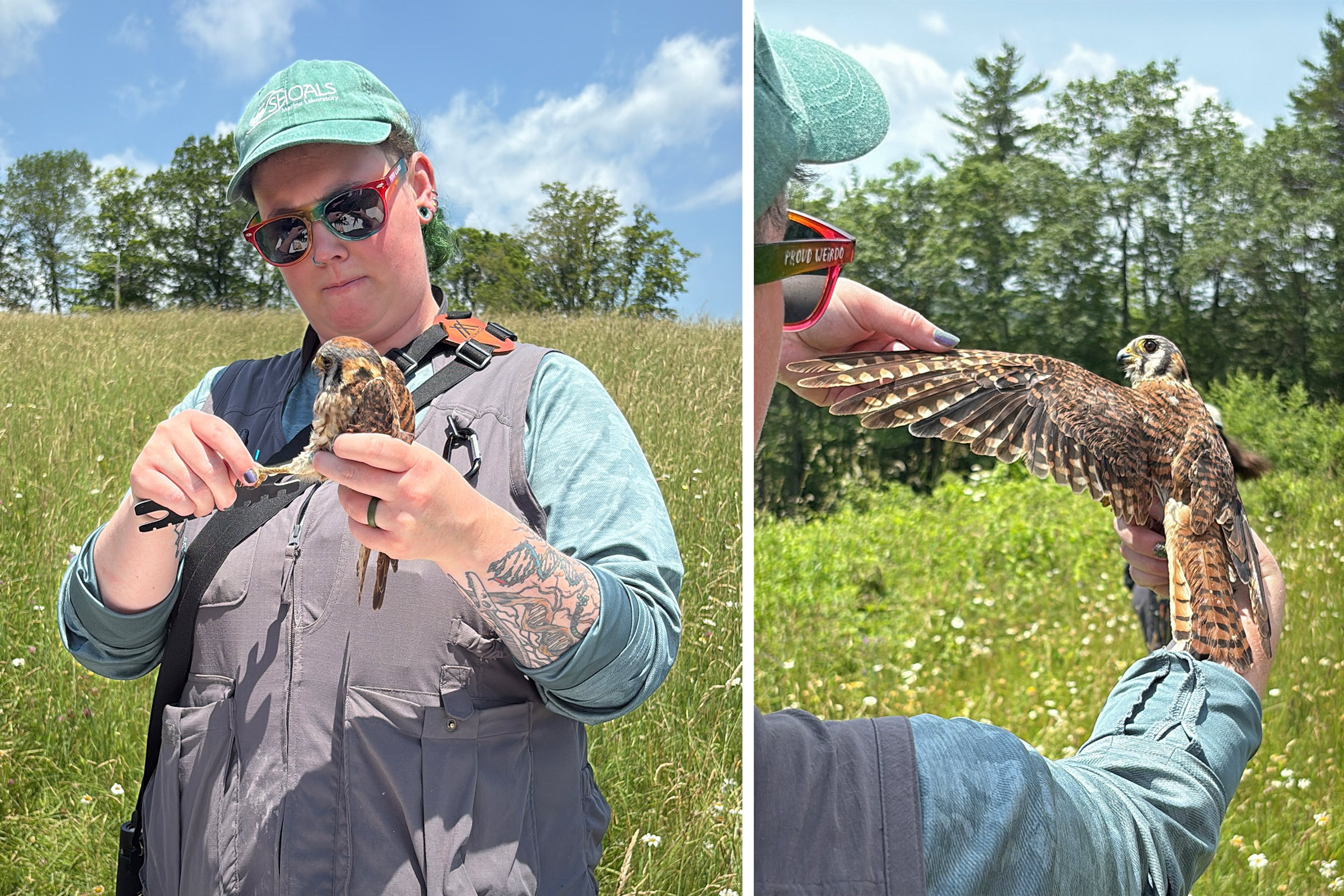
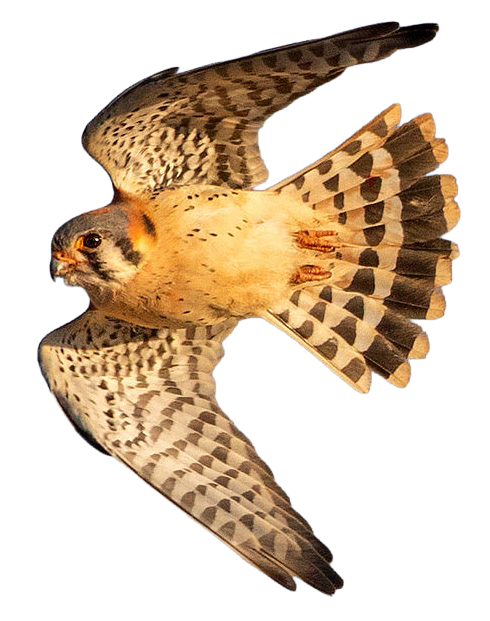
Master bander Lindsay Herlihy measures the leg of an adult kestrel in Harrisville to determine what size band is needed (left). The contrast between the male’s blue-gray wings and the female’s brown, barred wings (right) is a key field mark for identifying the sex of an American Kestrel.
(photos © Michelle Aldredge)
2025 Results – A Mixed Bag
Kestrel population recovery is gradual, with progress measured in small steps. Little by little, many nest boxes have seen attention from kestrels, and several have served as successful nesting sites.
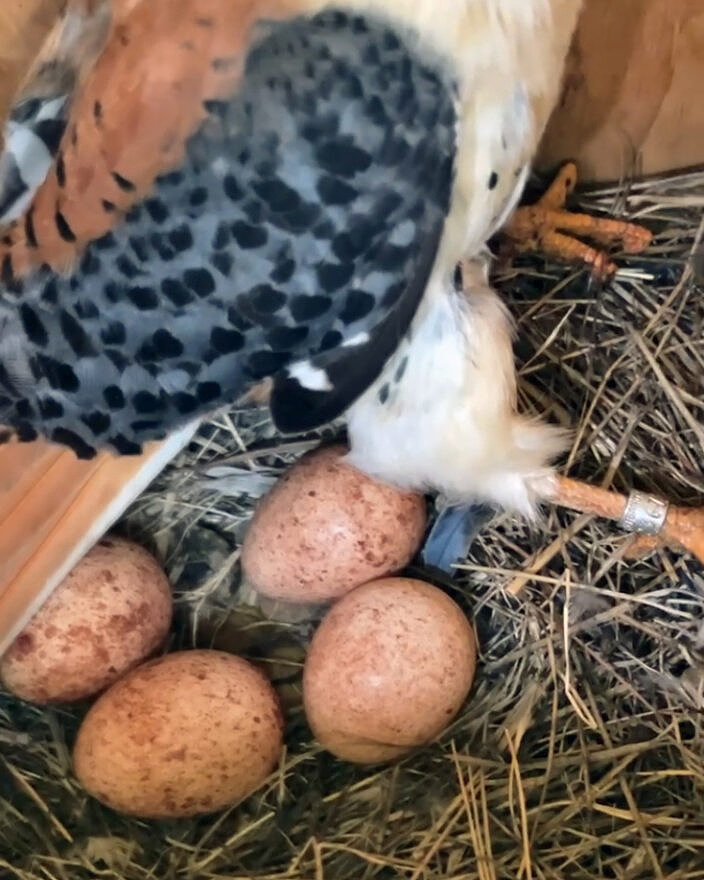
In June, Phil Brown was surprised to encounter this banded male tending eggs inside a kestrel box in Peterborough. (photo © Phil Brown)
Kestrels return to the Monadnock Region in March or April, lay eggs in May or June, and fledge their young by late July. This year, we recorded kestrel activity at 11 active territories, most in nest boxes. Five boxes produced fledglings (one fewer than 2024), yielding 21 young (down four from last year). Three of these sites were longstanding locations, showing strong site fidelity as adults returned to use the same nests. The other two boxes — in Harrisville and Peterborough — were brand new, offering encouraging signs of range expansion. Three former nest sites were unsuccessful this season, including one in Jaffrey where an adult became trapped in a hayloft — a hazard for kestrels due to their close association with farms and buildings.
Though kestrels attempted breeding at eight boxes in 2025, only five were successful, a drop from 16% nesting success in 2024 to just 10% in 2025. Eastern Bluebirds and Tree Swallows occupied 35 kestrel boxes this season. In at least two cases, kestrels took over active bluebird nests, evicting these birds and, in one instance, preying on an adult bluebird!
A new partnership with the Vermont Institute for Natural Science in 2025 allowed us to begin testing kestrels for lead and rodenticides. Preliminary results showed that chicks from one Walpole nest carried anticoagulant rodenticide, a known threat to raptors. Through this partnership, several chicks and one adult female now also sport color bands, enabling them to be identified in the field through binoculars or spotting scopes, and helping biologists track movement patterns.
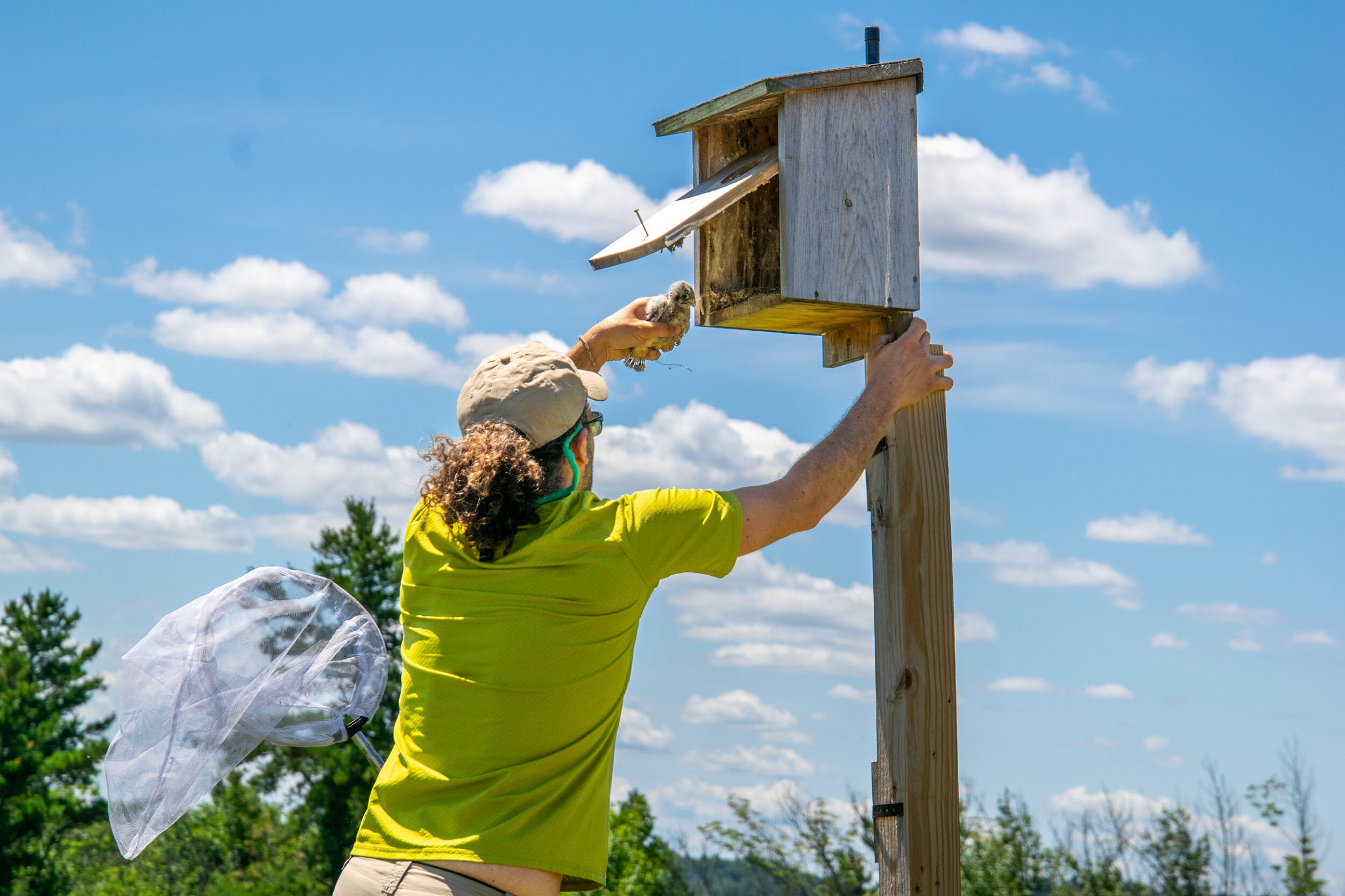
Phil Brown removes a kestrel chick from a box in Harrisville in preparation for banding. (photo © Corwin Levi)
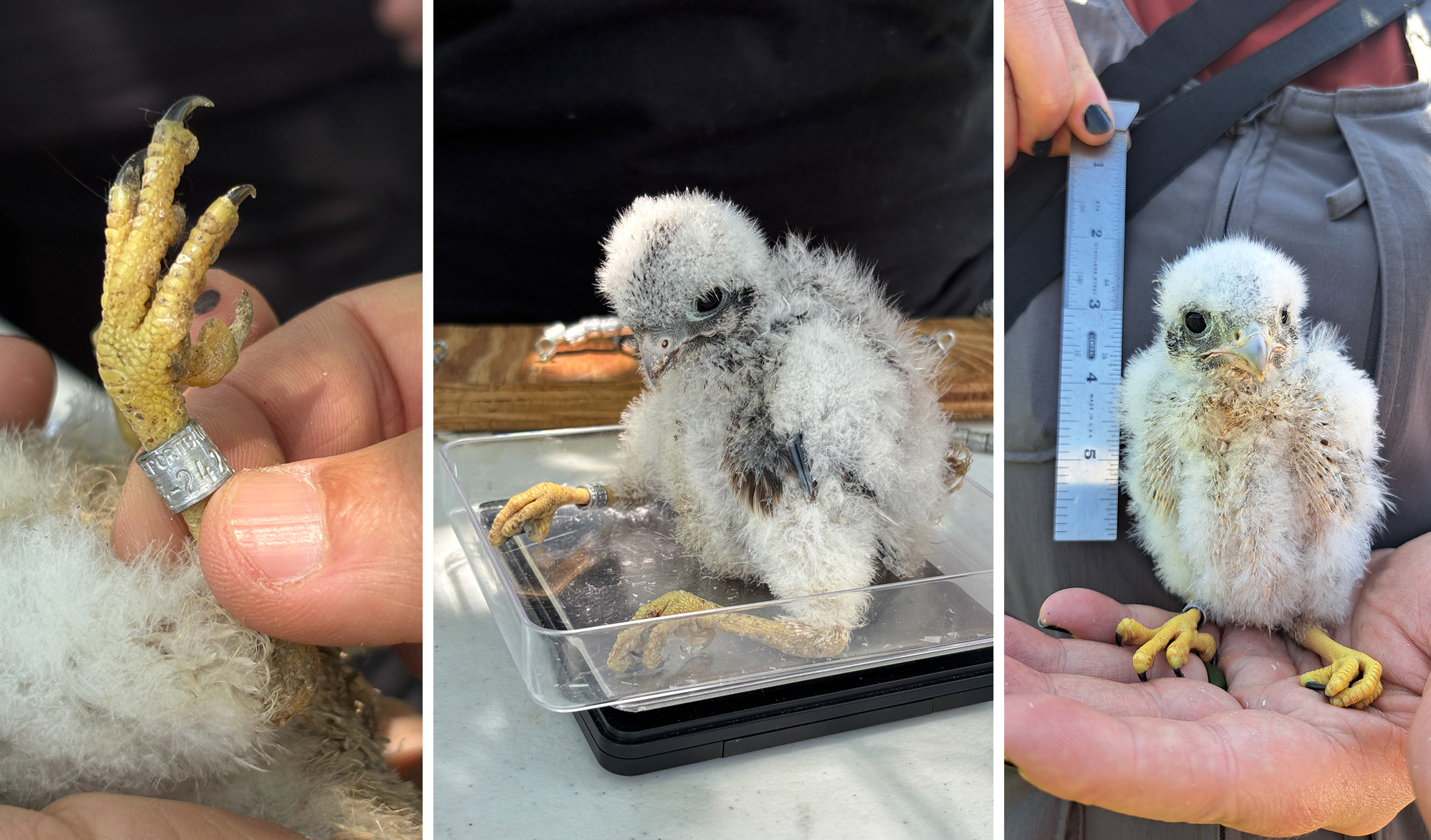
During the kestrel banding process, band numbers are recorded (left), and each bird is weighed (middle) and measured (right).
(photos © Michelle Aldredge & Lindsay Herlihy)
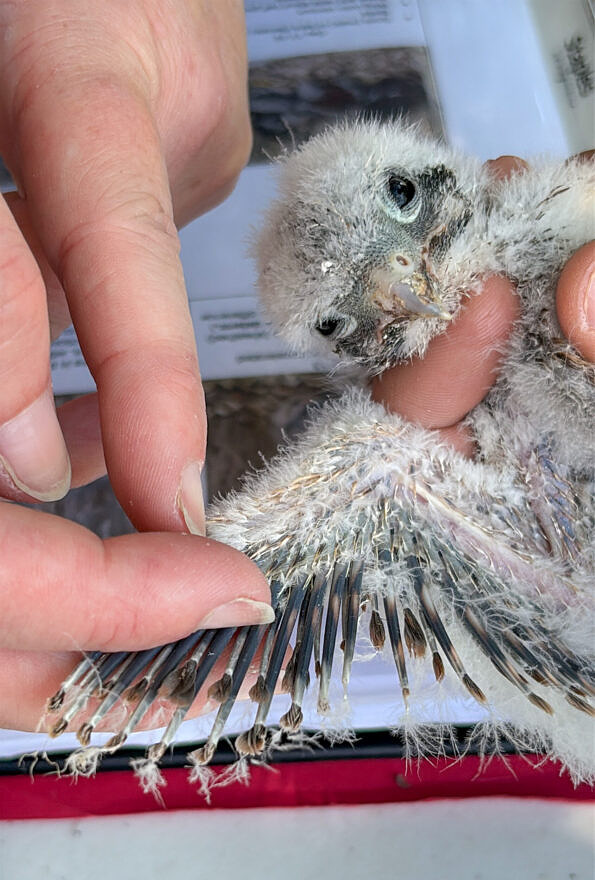
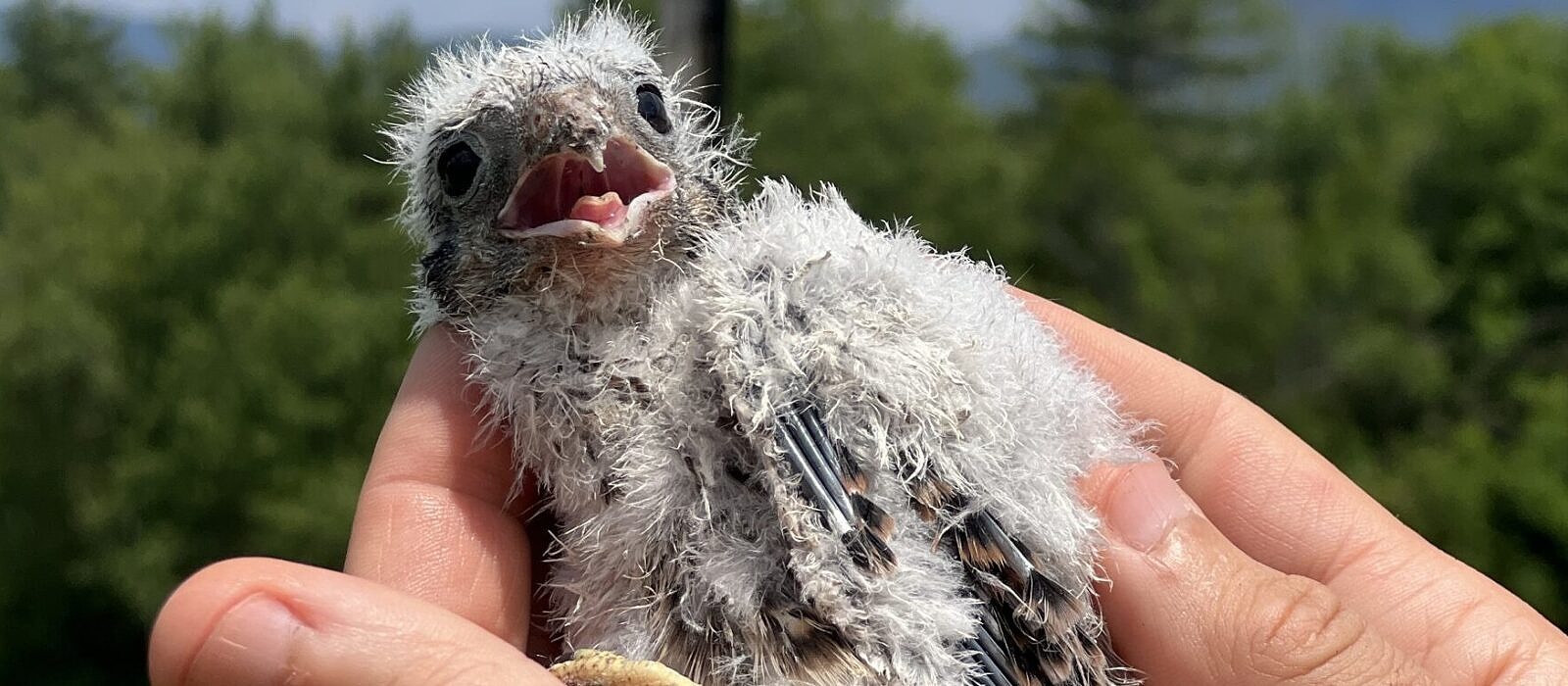
This young kestrel chick is sprouting pin feathers — new feathers encased in protective keratin sheaths that look a bit like quills. As the feathers grow, the sheaths flake away, eventually revealing the sleek flight feathers the bird will need for life on the wing. (photo © Michelle Aldredge)
Looking to the Future
With another year under our belts, our knowledge of kestrels continues to deepen, though our project — like other nest box programs — still faces challenges. We all have a role to play in stewarding kestrels —and all birds — more effectively.
Monitoring bird populations through long-term datasets — such as hawk watches and breeding bird surveys — along with public sightings via eBird, transmitter studies, and continued support for local and regional conservation efforts, is vital to understanding environmental change and maintaining local kestrel populations. Our goal is to expand management and research to help kestrels recover and reclaim their place in our precious open fields.
A world with kestrels is a better place. They add diversity to our landscape, provide natural pest control, and bring color, charisma, and adaptability to human-altered spaces. Above all, they offer moments of joy, wonder, and connection to the natural world. Protecting kestrels and stewarding open spaces go hand in hand — and benefit us all.
Thank You
Thanks to our dedicated supporters, volunteers, and landowners, we’ve fledged 62 banded kestrels over the past three seasons. Special thanks to master bander Lindsay Herhily for her tireless volunteer efforts, knowledge, and enthusiasm in banding and managing data, all of which is performed under federal and state permits.
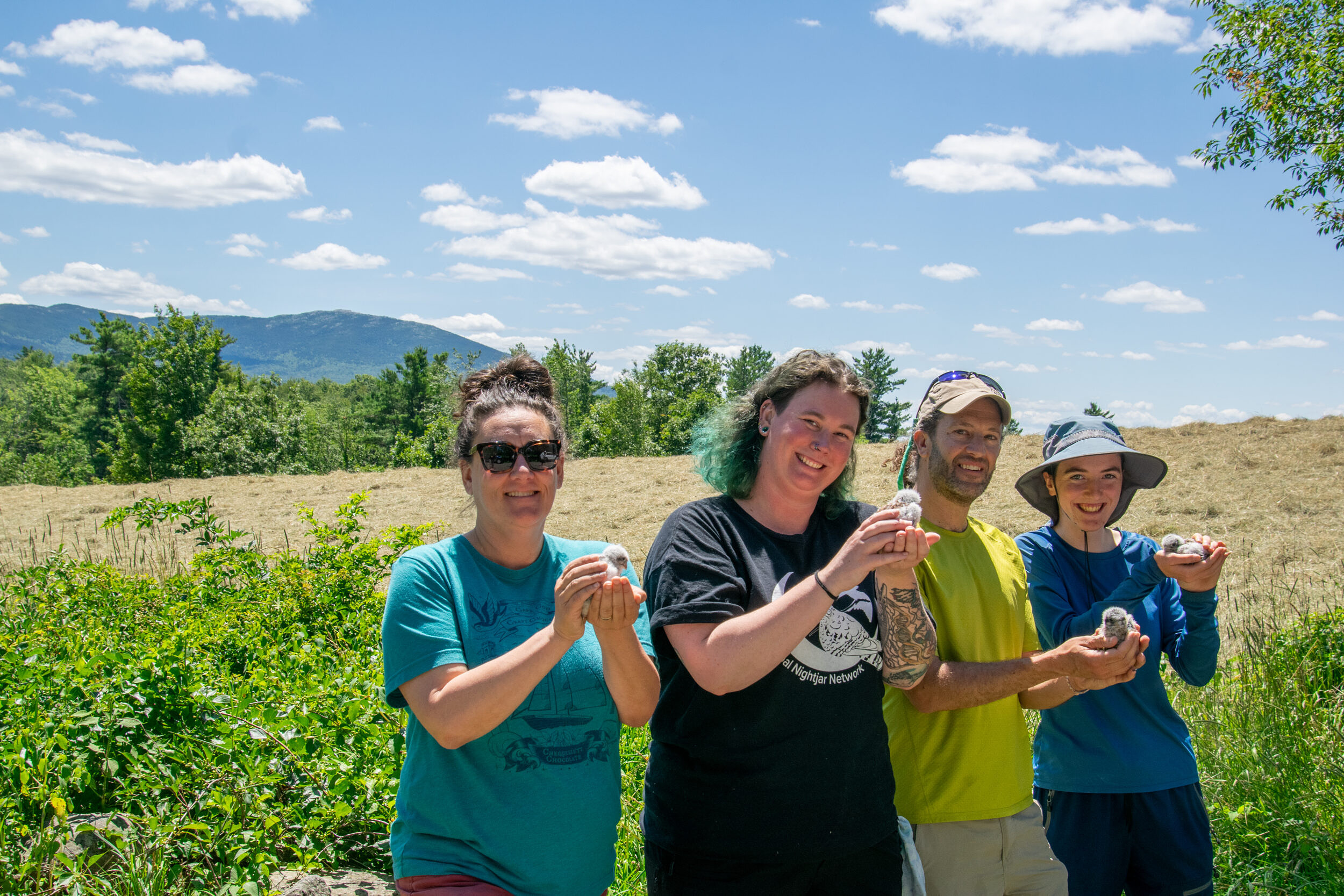
Science Director Brett Amy Thelen, master bander Lindsay Herlihy, Bird Conservation Director Phil Brown, and Wildlife Intern Kate McKay (left to right) show off four newly banded chicks from a kestrel box in Harrisville. (photo © Corwin Levi)
Support Our Kestrel Conservation Project


