Opening the Door to Nature
For many of us, spending time outdoors is essential — to our health, our spirit, and our sense of belonging. A walk in the woods, a quiet trailside moment, a place to breathe. But for millions of Americans, access to nature is shaped by barriers most of us never have to think about.
According to the Centers for Disease Control and Prevention (CDC), roughly one in four adults in the United States lives with a disability. Add in injuries, chronic pain, aging bodies, and temporary mobility challenges, and it becomes clear that outdoor spaces designed for only one kind of visitor leave many people behind.
Why Access Matters
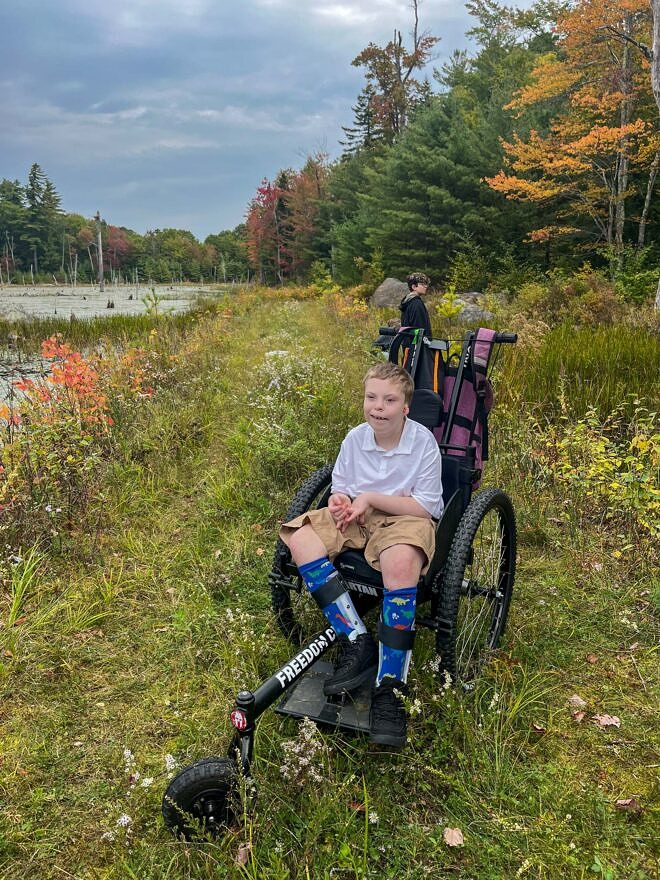
The Harris Center’s GRIT all-terrain wheelchair allowed Jackson, a 6th grade student from Keene Middle School, to enjoy a field trip to Cynthia’s Pond with the rest of his class. (photo © Karen Rent)
Access to nature isn’t just about recreation. Research shows that spending time outdoors is linked to reduced stress, improved mood, and improved mental health outcomes, including for people living with disabilities and chronic illness. The American Psychological Association has found that time in nature can support emotional wellbeing and stress reduction in meaningful ways.
Importantly, those benefits don’t require strenuous activity. Studies show that even passive experiences — such as sitting outdoors, watching birds, or simply viewing trees — can provide measurable mental health benefits, reducing rumination and supporting emotional wellness.
However, access, or the absence of it, can fundamentally change how someone experiences the outdoors. After an injury, nature can shift from a place of ease to a place of uncertainty — bringing questions about trail conditions, equipment, and support, and about whether nature centers, trails, and other outdoor spaces are designed with everyone in mind.
For many people, uncertainty alone is enough to keep them away. The National Park Service cites the lack of accessible facilities and unclear information as two of the most common barriers preventing people with disabilities from visiting outdoor spaces, underscoring how critical thoughtful design and clear communication can be.
Our Approach
At the Harris Center for Conservation Education, we believe that nature belongs to everyone — but inclusivity doesn’t happen by accident. Creating welcoming outdoor spaces takes intention, investment, and ongoing listening.
When you visit the Harris Center, here are some of the accessibility features you will find:
- Push-button door openers
- Wheelchair-accessible restrooms with grab bars
- Wheelchairs available for use inside the building and on the front deck
- A GRIT all-terrain wheelchair for use throughout our grounds and on nearby rail trails
- Benches with armrests for resting and enjoying scenic views
- Nature for All outings designed for those who experience mobility challenges
- Assistive listening devices (hearing loops) for in-person lectures & events
- Closed captioning for Zoom programs
- Language options and accessibility tools on our website
- The Eleanor Briggs Open Lodge, a new outdoor gathering space and landscape project with enhanced accessibility features (opening in summer of 2026)
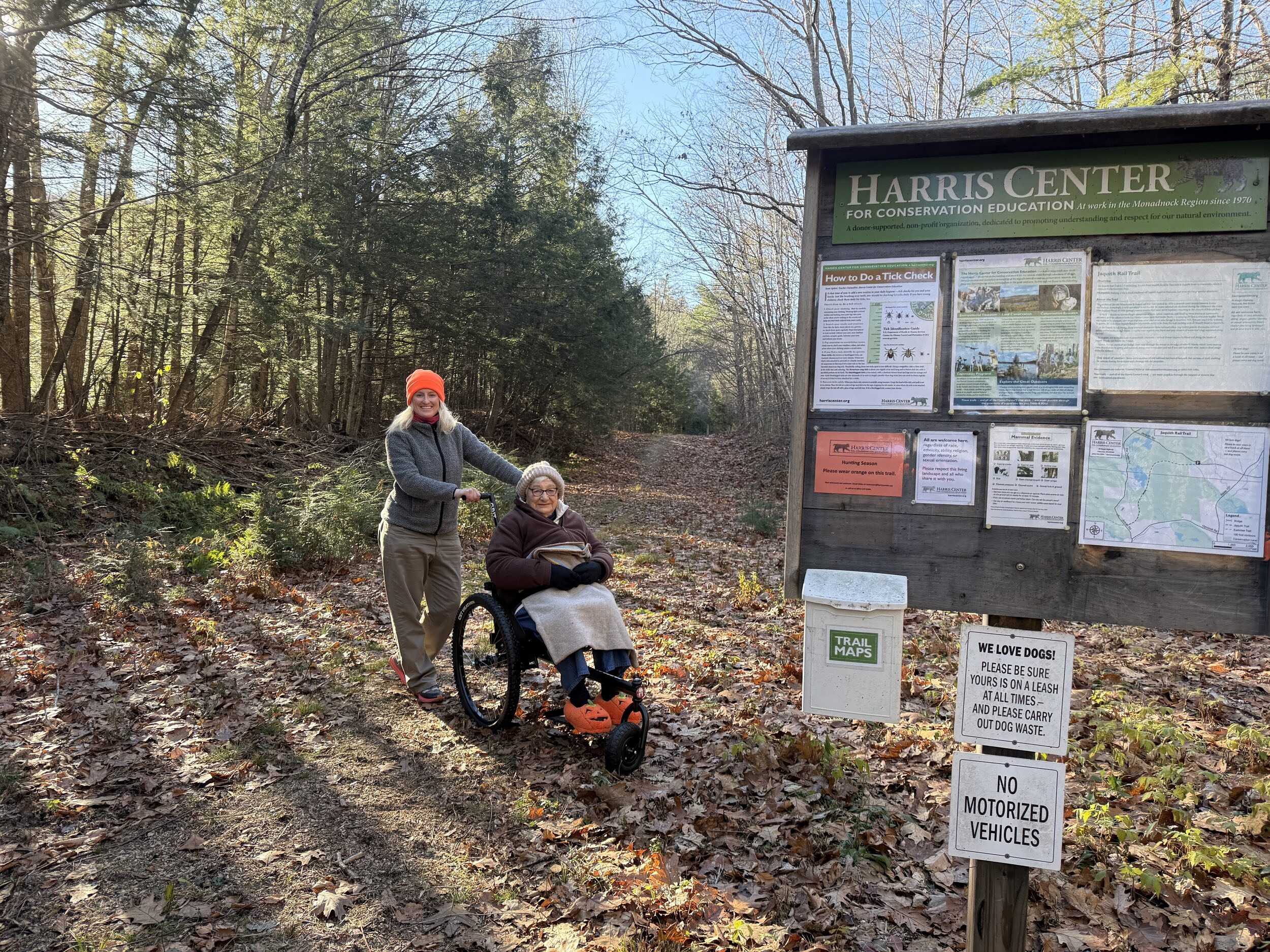
Stephanie Seavy and her 100-year-old friend Eleanor McQueen used the GRIT wheelchair to explore the Jaquith Rail Trail. (photo © Mary Verrilli)
An Ongoing Commitment
This work is at the heart of our Nature for All commitment. Accessibility is not a single feature or a finished project — it’s an ongoing practice that shapes how we design spaces, offer learning opportunities, and welcome people into the natural world.
In a culture where outdoor magazines and social media often celebrate speed, distance, and endurance, we affirm that being in nature doesn’t have to mean going farther or doing more. Sometimes, simply sitting outside in the fresh air can be profoundly restorative and spiritually uplifting. That experience — quiet, grounding, and deeply human — should never feel out of reach.
Our work is far from finished. But we remain committed to opening doors, creating paths, and ensuring that nature is a place where everyone can belong. Because when we hold the door to nature open, everyone benefits.

Your Gift Makes a Difference
Thanks to our incredible community of supporters, the Harris Center continues to protect wild places, educate people of all ages, and conduct vital conservation research. Your generosity makes everything we do possible — from preserving habitat for bobcats and birds to inspiring the next generation of environmental stewards.
We invite you to make a gift today to help sustain this important work. On behalf of the turtles, trees, wildflowers, salamanders, and butterflies — and the people who cherish them and our wild places — thank you!


