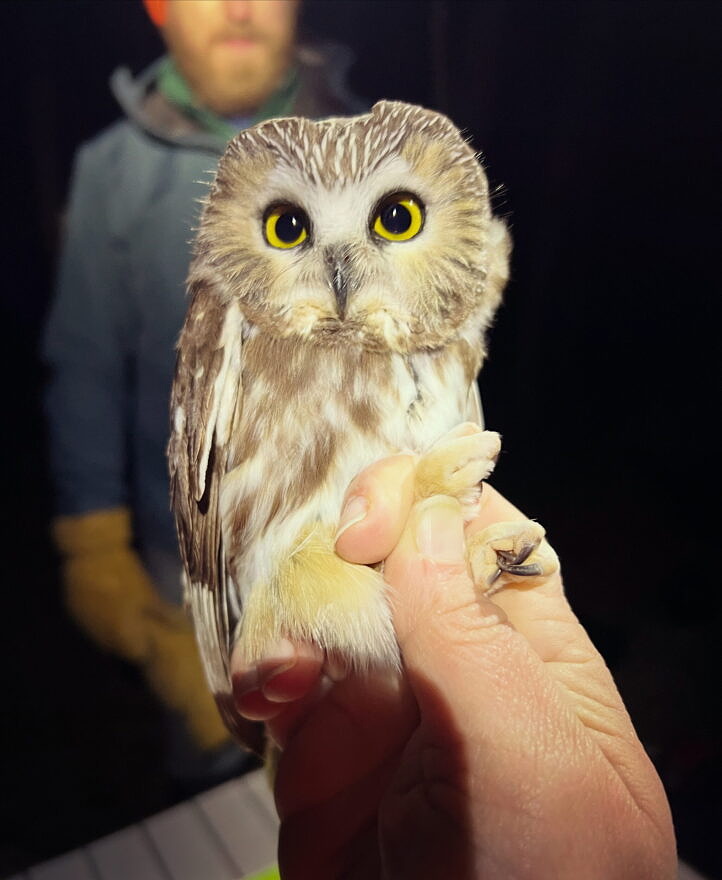
One of 131 saw-whet owls banded by the Harris Center’s team in 2025. (photo © Brett Amy Thelen)
An Owl’s Eye View of Saw-whet Season 2025
In the fall of 2025, the Harris Center completed our fourth consecutive season of Northern Saw-whet Owl (Aegolius acadicus) banding on SuperSanctuary lands as part of Project Owlnet. Our banding station is one of more than 100 sites across North America that monitor the fall migration of this charismatic owl species.
Why Band Northern Saw-whet Owls?
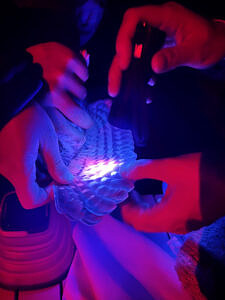
The banding team uses a blacklight to examine flight feathers for the presence of porphyrin – a pigment that glows pink under blacklight when the feathers are fresh (new). This information can help determine the owl’s age. (photo © Brett Amy Thelen)
Saw-whet owls are small, secretive, and nocturnal, which makes them difficult to study. Because saw-whets are rarely seen by humans, banding is one of the best tools we have for tracking changes in saw-whet populations, understanding migratory routes and migration timing, documenting longevity and survival in the wild, and more. Furthermore, though they’re currently considered common, the National Audubon Society has identified the Northern Saw-whet Owl as a climate-vulnerable species. As saw-whets continue to face threats from climate change, habitat loss, rodenticide poisoning, vehicle collisions, and other dangers, long-term monitoring like the research conducted at our banding station will be critical to their conservation.
Methods
Banding took place on alternating evenings at two different sites on Harris Center lands. Sites were selected based on land ownership, forest cover, slope, access, and distance from residential areas. At each site, researchers set up a temporary array of fine “mist nets” and played an audio loop of a male saw-whet toot-toot-toot call to lure passing owls toward the nets. The nets were checked every 10 to 30 minutes, and any owls were carefully removed by trained individuals and transported to the banding table in cloth bags, which help keep the birds calm. Each owl was then weighed, measured, examined to determine age and sex, and outfitted with a lightweight metal USGS band containing a unique number before being placed back into a cloth bag to re-adjust to the dark and then released back to the wild.
The safety of the owls was our top priority. All banding was conducted under a federally authorized Bird Banding Permit issued by the U.S. Geological Survey’s Bird Banding Lab (BBL). Experienced owl bander Hillary Siener led the station operations as a sub-permittee under Dr. Jonathan Atwood’s master banding permit from the BBL, in accordance with a scientific permit from NH Fish and Game, and according to protocols established by Project Owlnet.
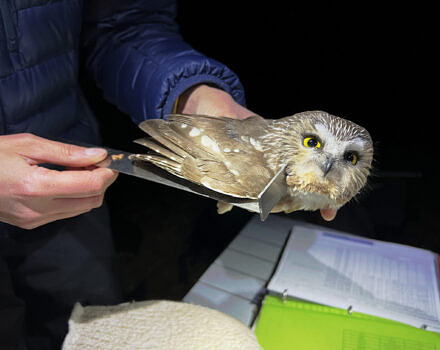
Male saw-whet owls do not differ visually from females, but wing measurements, taken together with weight, can help determine the sex of each bird. (photo © Brett Amy Thelen)
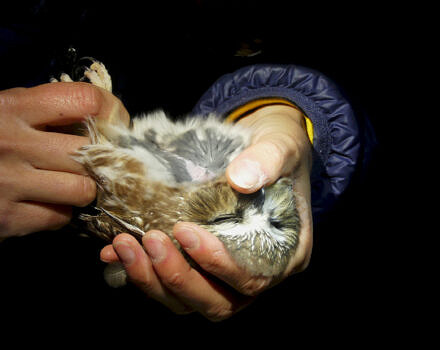
Blowing on an owl’s underside helps banders assess the amount of fat in the bird’s furculum (or “wishbone”) and the condition of the pectoral muscles around the bird’s keel, both measures of overall health. (photo © Annamarie Saenger)
Findings
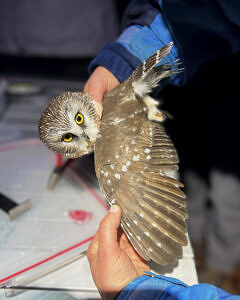
Flight feathers molt and re-grow in predictable patterns, so examining feather wear enables banders to assess a bird’s age.
(photo © Brett Amy Thelen)
In 2025, our team captured 140 saw-whet owls over the course of 26 nights between October 4 and November 15, for an average of 5.4 owls per night. October 17 had the highest number of captures with 15 owls, and there were two nights with no owls. Migration timing peaked the week of October 19 to 25. The 100th owl of the season was caught on October 27.
125 (89%) of the owls we captured were female, 3 (2%) were male, and 12 (9%) were of unknown sex. The higher proportion of females is typical at saw-whet owl banding stations. Though playing the male’s advertising call may attract more females and/or deter males, there is also growing evidence to suggest that saw-whets may have a sex-differentiated migration, with males not migrating or not migrating as far as females.
The majority of owls (96, or 69%) were in at least their second year of life (hatched in 2024 or before); 44 (31%) were hatch-year birds (hatched in 2025). At least three owls were 4 years old.
The most exciting part of the project is when we capture an owl that is already wearing a band. This season, nine of the owls we captured were already banded. One owl banded in Tadoussac, Quebec, was captured 38 nights later at our site, traveling a straight-line distance of 374 miles, for an average of 9.8 miles per night. The other owls were banded in previous seasons (2024 or earlier) in Montpelier, Vermont; Williamstown, Massachusetts; Hilton, New York; Bradford, Pennsylvania; Burkittsville, Maryland; Fairmont, West Virginia, and — of particular note — stations far to the west of us in Amherst, Wisconsin, and Ignace, Michigan. The Ignace owl was encountered at our New Hampshire station almost exactly one year after she was banded in northern Michigan.

A map showing where saw-whet owls banded on Harris Center lands from 2022 to 2025 have subsequently been encountered, and where banded owls encountered at Harris Center sites were originally banded. Solid lines indicate same-season encounters, and represent general direction of travel. Dashed lines connect prior-season encounter locations, but do not necessarily represent migration pathways as more than one migration season had occurred between captures. Click on the graph to open a larger view.
(map by Nate Marchessault & Mike Valentino)
In addition, four owls banded by us were encountered by others in 2025. One owl, banded at our station in 2024, was captured on two different nights in early November at a banding station in Williamstown, Massachusetts. Another was encountered in Egremont, Massachusetts, just five nights after she was banded at our site, which means she traveled an average of 18.6 miles per night. A third owl took a more leisurely track, showing up at a banding station in Berlin, Massachusetts, 24 nights after she was banded by us; though she likely made stopovers along the way, this represents an average of just 2.0 miles per night. Sadly, the last of the four was found dead in March 2025 after being apparently hit by a car in Auburn, Maine. From our banding records, we know that she was at least 5 years old at the time of her death.
The Beginnings of a Long-Term Dataset
We are thrilled to now have four full years of data, which begins to allow comparisons from year to year, as well as the detection of long-term trends. Since 2022, we have captured 441 unique saw-whet owls. We have also recorded 30 between-site encounters — that is, owls who were either banded by us and subsequently encountered elsewhere, or banded at another station and subsequently captured by us. Every one of these owls contributes to our collective scientific understanding of the migratory behavior, population trends, and conservation needs of this remarkable species.
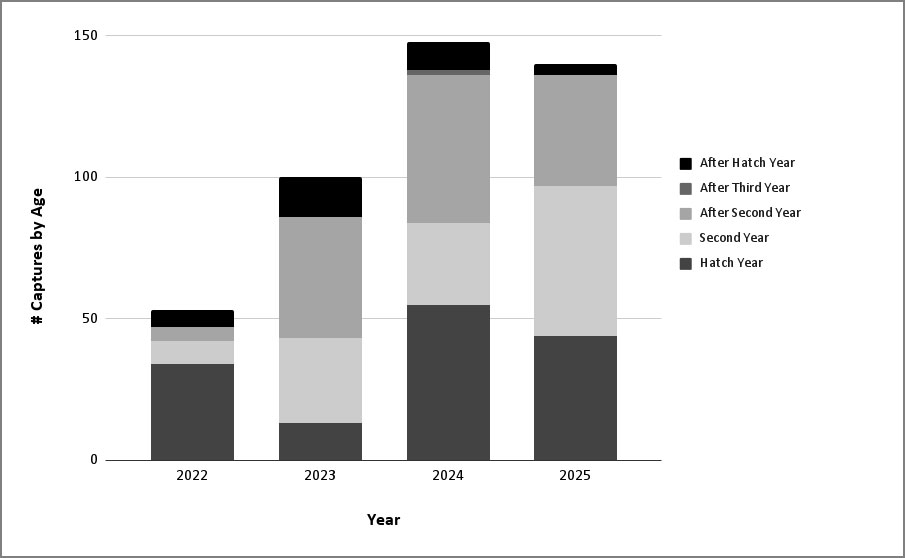
Number of saw-whet owls captured during the first four seasons of the Harris Center’s owl banding project, by agre. Click on the graph to open a larger view. (graph © Hillary Siener)
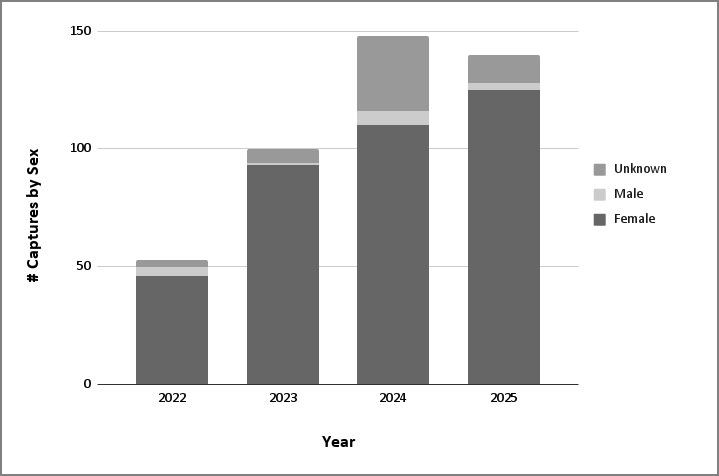
Number of saw-whet owls captured during the first four seasons of the Harris Center’s owl banding project, by sex. Click on the graph to open a larger view. (graph © Hillary Siener)
Education & Outreach
To share the magic of saw-whet owls and to foster greater understanding of the scientific value of bird banding, the Harris Center offered six educational owl banding demonstrations in 2025, including programs for adults, families, and graduate students in an Antioch University New England ornithology class. Thankfully, at least one owl made an appearance at each event, allowing more than 80 people to observe both the banding process and the unique features that make an owl an owl. Keep your eye on our online calendar in early September for the chance to see saw-whet science in action in 2026. These programs fill fast!
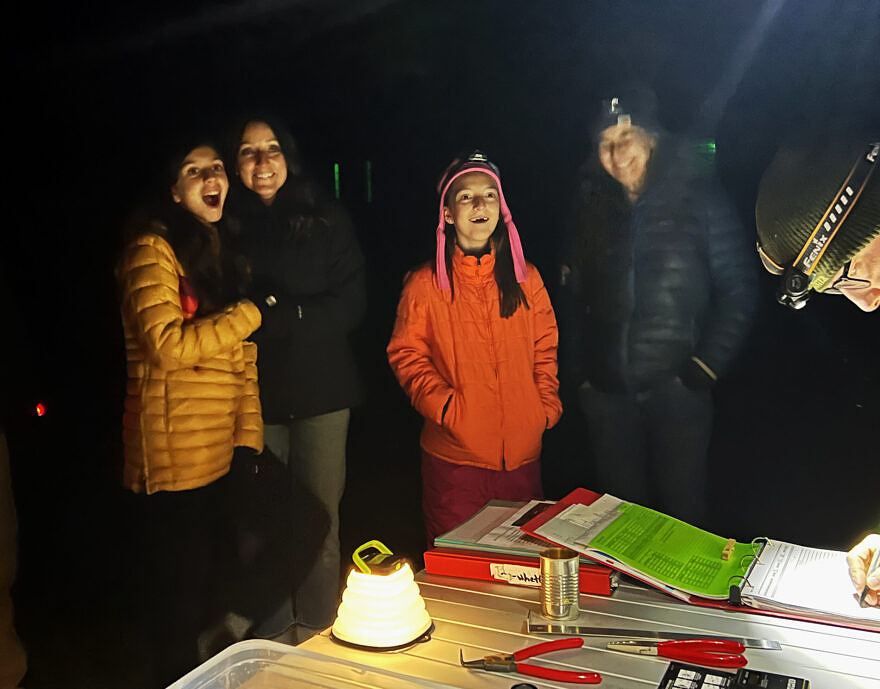
The face people make when they see a saw-whet owl for the very first time at a banding demonstration! (photo © Brett Amy Thelen)
Adopt-an-Owl Program
Now in its third year, the Harris Center’s Adopt-an-Owl program allows people to support our saw-whet banding project by symbolically adopting an owl. Each adoption comes with a certificate that includes the owl’s band number, age, sex, and weight, and the date it was banded. We also notify the adopter if their owl is encountered again anywhere in North America. As of January 2026, 230 owls have been adopted by people in 30 states and five European countries! To learn more and adopt an owl as a gift for yourself or a loved one, visit our Adopt-an-Owl page.
Acknowledgments
This project would simply not be possible without the hard work, late nights, and dedication of our 16 owl-loving volunteers, who assisted with everything from net setup to banding operations to data entry. Six Harris Center staffers also contributed their time and talents to the project, including work on nightly banding, educational events, volunteer training and coordination, data entry and analysis, preparation of scientific permit and grant applications, and behind-the-scenes planning. Together, Harris Center staff and volunteers contributed more than 750 hours to this project in 2025. Special thanks to superstar Austin Gelinas, who volunteered 127 hours this season alone – not including travel time to and from the banding sites!
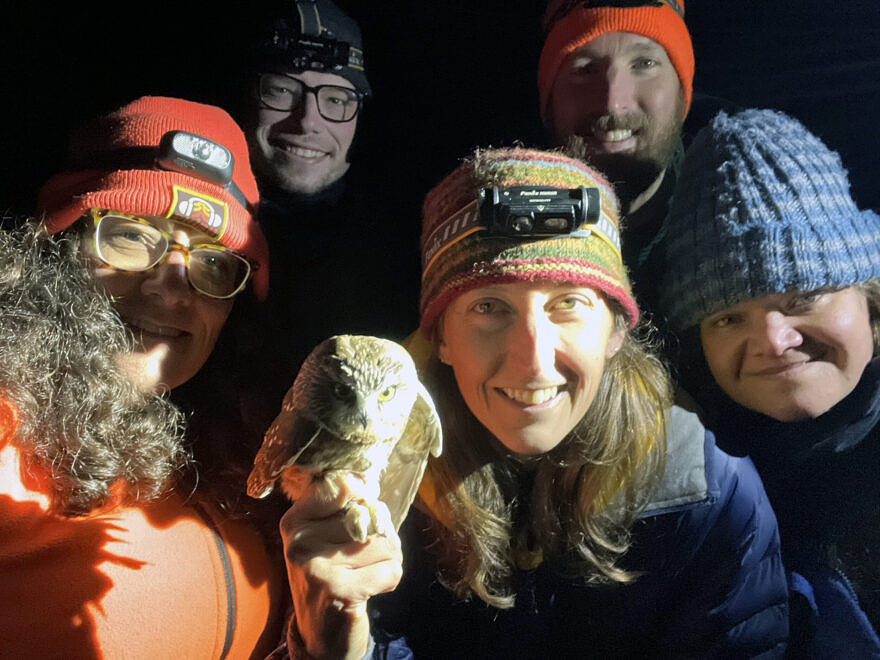
The banding team with the last owl of the 2025 season. From left to right: Brett Amy Thelen, Austin Gelinas, Hillary Siener, Michael Nork, and Annamarie Saenger. (photo © Brett Amy Thelen)
This year’s team of hardy, headlamp-wearing night owls included Jonathan Atwood (master bander), Julie Brown, Phil Brown, Russell Cobb, Austin Gelinas, Wendy Gibbons, Lindsay Herlihy, Chris Liazos, Nate Marchessault, Kate McKay, Cynthia Nichols, Michael Nork, Polly Pattison, Annamarie Saenger (banding assistant), Tricia Saenger, Cliff Seifer, Hillary Siener (lead bander), Susie Spikol, Logan Stecker, Brett Amy Thelen, Dan Wenny, and Emily Wrubel.
Heartfelt thanks to all for their excellent company in the chilly, starlit woods and for all the gear hauling, net opening, net closing, data recording, weather watching, midnight driving, and cold toes on behalf of our beloved saw-whets!
This year’s project was made possible through support from the Davis Conservation Foundation and donors to our Adopt-an-Owl program.
Contact Us
For more information on the Harris Center’s saw-whet owl banding efforts, please contact Science Director Brett Amy Thelen.


